J Res Health Sci. 19(2):e00446.
Original Article
Pediculosis humanus capitis Prevalence as a Health Problem in Girl’s Elementary Schools, Southwest of Iran (2017-2018)
Hoda Ghofleh Maramazi 1, Mona Sharififard 1, Elham Jahanifard 1, *, Elham Maraghi 2, Mohammad Mahmoodi Sourestani 3, Amal Saki Malehi 2, Sima Rasaei 4
Author information:
1Department of Medical Entomology and Vector Control, School of Public Health, Ahvaz Jundishapur University of Medical Sciences, Ahvaz, Iran
2Department of Biostatistics and Epidemiology, School of Public Health, Ahvaz Jundishapur University of Medical Sciences, Ahvaz, Iran
3Department of Horticultural Science, Faculty of Agriculture, Shahid Chamran University of Ahvaz, Ahvaz, Iran
4Department of Dermatology, School of Medicine, Ahvaz Jundishapur University of Medical Sciences, Ahvaz, Iran
Abstract
Background: Head lice as obligated ectoparasite is a public health concern. We aimed to determine the prevalence of Pediculus humanus capitis as public health concern among girl’s primary school in southwest of Iran.
Study design: A cross-sectional study.
Methods: This study was conducted in Karoon County, south-west of Khuzestan Province in Iran in 2017-2018. Totally, 851 students were interviewed randomly, examined by a medical entomologist and completed a questionnaire containing 18 questions based on individual, social, economic, cultural and health information.
Results were presented as prevalence and percentages for qualitative variables and also, the data were analyzed by univariate logistic and multivariate regression models. Results: About 199 (23.38%) girls were infected by head lice. Univariate logistic regression indicated that the prevalence of pediculosis was directly associated with the grade of education, father’s job, shared personal hygiene products, number of combing, having permanent head cover at home, infection in other members of the family and previous infection. Multivariate logistic regressions for predicting of head lice infection in girl students were reported permanent head cover at home (OR: 1.399, 95% CI: 0.934, 2.097, P=0.104), grade of education (OR: 1.948, 95% CI: 1.307, 2.905, P=0.001), father’s job (OR: 2.385, 95% CI: 1.518, 3.750, P<0.001), shared personal hygiene products (OR: 1.817, 95% CI: 1.224, 2.698, P=0.003) and using hair oil (OR: 1.904, 95% CI: 1.279, 2.836, P=0.002) had significant relation with head lice infestation
Conclusion: Head lice remind as serious health problem in Karoon County, southwest of Iran. Due to high infestation, periodic screening of the student is recommended for early detection and treatment.
Keywords: Lice infestation, Pediculosis, Head lice
Copyright and License Information
© 2019 The Author(s); Published by Hamadan University of Medical Sciences.
This is an open-access article distributed under the terms of the Creative Commons Attribution License (http://creativecommons.org/licenses/by/4.0), which permits unrestricted use, distribution, and reproduction in any medium, provided the original work is properly cited.
Citation: Ghofleh Maramazi H, Sharififard M, Jahanifard E, Maraghi E, Mahmoodi Sourestani M, Saki Malehi A, Rasaei S. Pediculosis humanus capitis Prevalence as a Health Problem in Girl’s Elementary Schools, Southwest of Iran (2017-2018). J Res Health Sci. 2019; 19(2): e00446.
Introduction
Lice as obligated ectoparasites have a long association with the human host and indicate a co-evolution between hosts and parasites1, 2. Overall, humans have been infested by lice and they spread according to human migrations out of Africa. The oldest head lice were reported on 8000-year-old fossil man in Brazil3.
Blood-sucking lice belong to the suborder of Anoplura and Pediculidae family is a wingless insect that feeds on sebaceous secretions and body fluids 4, 5. Nowadays, humans are the host of three lice species, including the head louse, the body louse and the pubic louse6, 7. Severe infection with the three species of lice leads to pediculosis7. Human head lice divided into A, B and C clad3. Furthermore, the separation of clade A happened into species (Pediculus humanus and P. capitis) or subspecies (Pediculus humanus capitis and P. humanus humanus) regarding mitochondrial DNA studies since the late 1970s8. Head and body lice have distinct differences in average size, color, behavioral and physiological adaptations, antennae forms and indentations between abdomen segments. P. humanus capitis do not carry diseases, but body lice are the vector of diseases like louse-born typhus and trench fever7. A head louse is a public health concern in the world. The prevalence of the insect has been reported in the range of 0.48% to 37% in Europe9.
Head louse is a contagious infection that often feeds on children in a range of 3 to 12 yr, but it can spread to the rest of the family10. The ectoparasite is mostly observed in crowded areas with close personal contact including schools, kindergarten, nurseries, sports, playgrounds, camps and prisons11. Head lice are transmitted directly from person to person or indirectly through common use of the comb, brush, pillow and cloths12. All growth stages of head lice, including nits, nymphs, and adults are mostly observed near the neckline at the behind of the head and back of the ears7.
Various factors like parents’ education and job, family size, presence of the bathroom at home, frequency of bathing per week and shared personal hygiene products effects on head lice infestations13. The scalp itchy is already due to lice bite, saliva, and faces14. The other symptoms are depression, insomnia, fatigue, educational failure, mental disorder, decreases the social stigma and allergic reactions 5, 15. The majority of cases of infestations are unreported due to social stigma16.
The prevalence of head lice was reported from 0.48% in Isfahan Province in the center of Iran to 27% in Sistan and Baluchistan in the southeast of the country17. The variation of head lice infestation rate is maybe due to lice resistance to treatment, socioeconomic status, poor healthcare, hair washing habits, family size, low knowledge about pediculosis, perception of head lice as a health problem, public culture, spatiotemporal distribution of hosts and lack of personal health18.
Regarding the cultural, social, health and economic status of Karoon County, as well as the lack of information about the prevalence of head lice infestation in the Khuzestan Province, the goal of this investigation was to determine the prevalence of P. humanus capitis as public health concern among girl’s primary schools in this county in southwest of Iran during 2017-2018.
Methods
Study area
Karoon County (30°26'N, 48°10'E) situated in south-west of Khuzestan Province in Iran (Figure 1). The county is divided into two districts including the Central and Soveyseh Districts. Kut-e Abdullah is the center of the county. The county has a warm, humid climate that temperatures reach above 50 °C during the warm summer season.
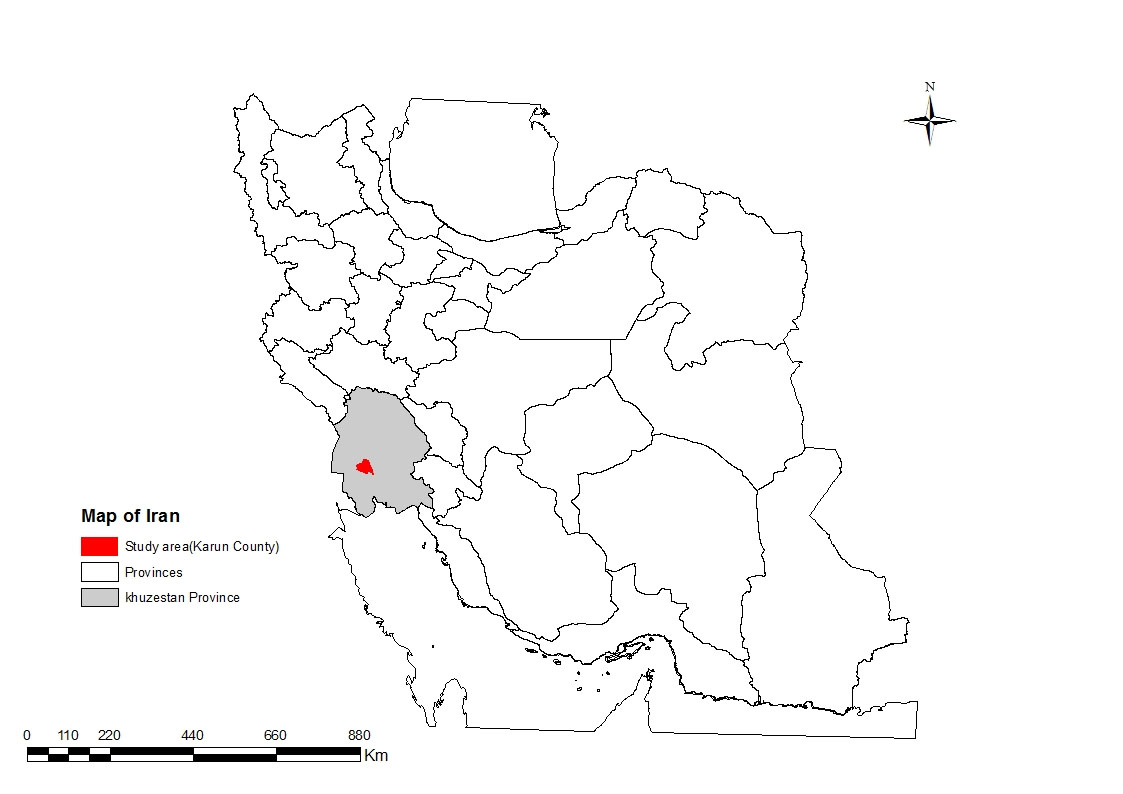
Figure 1.
Study area, Karoon County, Khuzestan Province, southern Iran
.
Study area, Karoon County, Khuzestan Province, southern Iran
Study design
This cross-sectional study was conducted during 2017-2018 in Karoon County, Iran. Inclusion criteria were sex (girl students), the grade of education, and governmental schools. An exclusion criterion was defined as a disagreement with parents. A questionnaire containing 18 questions based on an individual, social, economic, cultural and health information like location, grade of education (in educational system of Iran County, primary schools have six levels, entitled as "grade": grade I (7 yr old students), grade II (8 yr old students), grade III (9 yr old students), grade IV (10 yr old students), grade V (11 yr old students) and grade VI (12 yr old students), parent’s job, the number of students in class, family size, shared personal hygiene products (hairbrush, comb, towel, pillow, bed, hat), number of combing, Health care teacher at school, number of bathing per week, having itching, dandruff and head cover, hair type, using hair oil, background of family infestation, previous infestation and treatment type.
This project confirmed in the Ethical Committee of Ahvaz Jundishapur University of Medical Sciences and received cod no. IR.AJUMS.REC.1396.418. The permission to determine the prevalence of the lice infestation was allowed from the health unit in the schools and Education and Training, Office of the province. Moreover, informed consents designed by Ahvaz Jundishapur University of Medical Sciences were given to the students one day before and their parents’ signatures show their agreement that children took part in the project.
Sample size & completing questionnaire
The statistical community in this epidemiological study included girl primary school students, both urban and rural areas. The county has 30 girls' schools with 7963 students. The sample size was calculated by assuming an expected prevalence (p) of 11% with a 95% confidence and using the formula: n=pqz2 / d2. In which z=1.96, q=1- p=89% and d=0.2*p. Therefore, with 10% drop out rate, the sample size was computed as 855. The sample size was determined in each school proportional to the number of students.
Students were examined visually by combing the hair and directly interviewed to complete the questionnaire. Postgraduate medical entomology student was inspected the behind of the ears and the neck under hairs and scalp for five minutes19 to find nits, nymph, and adult of P. capitis.
Statistical analyses
Results were presented as absolute frequencies and percentages for qualitative variables. First, univariate logistic regression models were used to examine whether there were relationships between the role of predictor variables and pediculosis status. The odds ratio (OR) was calculated and presented with a 95% confidence interval (95% CI). Any variable having a P-value less than 0.20 was selected as a candidate for the multiple logistic regression analysis. Backward stepwise logistic regression modeling was then used to obtain a subset of factors associated with pediculosis infection. Statistical analysis was performed using the statistical software SPSS 18.0.0. (SPSS Inc. Chicago, IL, USA). A P-value of less than 0.05 was considered significant.
Results
About 851 students took part in this survey and 199 (23.38%) girls were at least infected with one of the growth stages of the parasite (nit, nymph and adult). The mean age of students was 9.42±1.68 (Infected: 8.81±1.54, Non-infected: 9.60±1.60) yr (Table 1).
Table 1.
Prevalence of head lice with socio-demographic and other associated factors
|
Variable
|
With p ediculosis
|
Without p ediculosis
|
Total
|
|
Number
|
Percent
|
Number
|
Percent
|
Number
|
Percent
|
| Location |
|
|
|
|
|
|
| Urban |
144 |
72.4 |
452 |
69.3 |
596 |
70.0 |
| Rural |
55 |
27.6 |
200 |
30.7 |
255 |
30.0 |
| Number of students in class |
|
|
|
|
|
|
| <30 |
73 |
39.7 |
236 |
39.7 |
309 |
39.7 |
| ≥30 |
111 |
60.3 |
357 |
60.3 |
468 |
60.3 |
| Grade of education |
|
|
|
|
|
|
| I–III |
139 |
69.8 |
307 |
47.1 |
446 |
52.4 |
| IV–VI |
60 |
30.2 |
245 |
53.9 |
405 |
47.6 |
| Father's Job |
|
|
|
|
|
|
| Employed |
138 |
72.6 |
532 |
85.4 |
670 |
82.4 |
| Jobless |
52 |
27.4 |
79 |
14.6 |
143 |
17.6 |
| Mother's Job |
|
|
|
|
|
|
| Employed |
18 |
9.1 |
44 |
6.8 |
62 |
7.3 |
| Housewife |
179 |
90.9 |
603 |
93.2 |
782 |
92.7 |
| Family size |
|
|
|
|
|
|
| Low population (≤4) |
48 |
24.1 |
175 |
26.8 |
223 |
26.2 |
| Medium population (5-7) |
130 |
65.3 |
416 |
63.8 |
546 |
64.2 |
| Crowded |
21 |
10.6 |
61 |
9.4 |
82 |
9.6 |
| Shared personal hygiene products |
|
|
|
|
|
|
| Common |
82 |
41.2 |
168 |
25.8 |
250 |
29.4 |
| Uncommon |
117 |
58.8 |
484 |
74.2 |
601 |
70.6 |
| Number of combing per day |
|
|
|
|
|
|
| 0-1 |
53 |
27.3 |
108 |
16.8 |
161 |
19.2 |
| >1 |
141 |
72.7 |
535 |
83.2 |
676 |
80.8 |
| Father's education |
|
|
|
|
|
|
| Illiterate |
18 |
9.7 |
41 |
6.6 |
59 |
7.4 |
| Educated |
167 |
90.3 |
574 |
93.4 |
741 |
92.6 |
| Mother's education |
|
|
|
|
|
|
| Illiterate |
36 |
19.2 |
78 |
12.5 |
114 |
13.9 |
| Educated |
152 |
80.8 |
551 |
87.5 |
703 |
86.1 |
| Number of bathing per week |
|
|
|
|
|
|
| 0-1 |
30 |
15.3 |
85 |
13.3 |
115 |
13.7 |
| >1 |
166 |
84.7 |
557 |
86.7 |
723 |
86.3 |
| Permanent head cover at home |
|
|
|
|
|
|
| Negative |
66 |
33.6 |
272 |
43.5 |
338 |
41.3 |
| Positive |
130 |
66.4 |
352 |
56.5 |
482 |
58.7 |
| Hair type |
|
|
|
|
|
|
| Straight |
140 |
70.4 |
459 |
70.4 |
599 |
70.4 |
| Curly |
59 |
29.6 |
193 |
29.6 |
252 |
29.6 |
| Using hair oil |
|
|
|
|
|
|
| No |
127 |
63.8 |
375 |
57.5 |
502 |
59.0 |
| Yes |
72 |
36.2 |
277 |
42.5 |
349 |
41.0 |
| Dandruff |
|
|
|
|
|
|
| Negative |
141 |
70.9 |
455 |
69.8 |
596 |
70.0 |
| Positive |
58 |
29.1 |
197 |
30.2 |
255 |
30.0 |
| Infected other family members |
|
|
|
|
|
|
| Negative |
164 |
84.2 |
623 |
97.2 |
787 |
94.2 |
| Positive |
31 |
15.8 |
18 |
2.8 |
49 |
5.8 |
| Previous Infection/treatment |
|
|
|
|
|
|
| Negative |
59 |
30.3 |
425 |
70.3 |
484 |
60.5 |
| Positive |
136 |
69.7 |
180 |
29.7 |
316 |
39.5 |
| Treatment type |
|
|
|
|
|
|
| Traditional |
75 |
65.3 |
101 |
64.4 |
176 |
64.7 |
| Chemical |
17 |
14.7 |
13 |
8.3 |
30 |
11.0 |
| Both |
23 |
20.0 |
43 |
27.3 |
66 |
24.3 |
Univariate logistic regression indicated that the prevalence of pediculosis was directly associated with grade, father’s job, shared personal hygiene products, number of combing, having a permanent head cover at home, infection in other members of the family and previous infection (Table 2).
Table 2.
Univariate logistic regression predicting head lice in students
|
Variables
|
OR (95% CI)
|
P
-value
|
| Location |
|
|
| Urban |
1.000 |
|
| Rural |
0.863 (0.607, 1.228) |
0.413 |
| Number of students in class |
|
|
| <30 |
1.000 |
|
| ≥30 |
1.005 (0.717, 1.409) |
0.967 |
| Healthcare Teacher at school |
|
|
| Positive |
1.000 |
|
| Negative |
1.161 (0.838, 1.609) |
0.369 |
| Grade of education |
|
|
| I–III |
1.000 |
|
| IV–VI |
0.384 (0.274, 0.539) |
0.001 |
| Father's Job |
|
0.001 |
| Employed |
1.000 |
|
| Jobless |
2.203 (1.493, 3.250) |
0.001 |
| Mother's Job |
|
|
| Housewife |
1.000 |
|
| Employed |
1.370 (0.777, 2.445) |
0.273 |
| Family size |
|
0.701 |
| Low population (≤4) |
1.000 |
|
| Medium population (5-7) |
1.139 (0.783, 1.658) |
0.469 |
| Crowded (≥8) |
1.255 (0.696, 2.264) |
0.450 |
| Shared personal hygiene products |
|
|
| Uncommon |
1.000 |
|
| Common |
2.019 (1.448, 2.815) |
0.001 |
| Number of combing per day |
|
|
| 0-1 |
1.000 |
|
| >1 |
0.462 (0.538, 1.325) |
0.462 |
| Father's education |
|
|
| Educated |
1.000 |
|
| Illiterate |
1.509 (0.845, 2.696) |
0.165 |
| Mother's education |
|
|
| Educated |
1.000 |
|
| Illiterate |
1.673 (1.084, 2.582) |
0.020 |
| Number of bathing per week |
|
|
| 0-1 |
1.000 |
|
| >1 |
0.462 (0.538, 1.325) |
0.462 |
| Permanent head cover at home |
|
|
| Negative |
1.000 |
|
| Positive |
1.522 (1.088, 2.130) |
0.014 |
| Hair type |
|
|
| Straight |
1.000 |
|
| Curly |
1.002 (0.708, 1.419) |
0.990 |
| Using hair oil |
|
|
| No |
1.000 |
|
| Yes |
0.768 (0.553, 1.419) |
0.114 |
| Dandruff |
|
|
| Negative |
1.000 |
|
| Positive |
0.950 (0.671, 1.346) |
0.773 |
| Infected other family members |
|
|
| Negative |
1.000 |
|
| Positive |
6.542 (3.570, 11.990) |
0.001 |
| Previous Infection/treatment |
|
|
| Negative |
1.000 |
|
| Positive |
5.443 (3.829, 7.737) |
0.001 |
| Treatment type |
|
0.240 |
| Traditional |
1.000 |
|
| Chemical |
1.760 (0.806, 3.847) |
0.156 |
| Both |
1.475 (0.760, 2.861) |
0.250 |
The descriptive study reported 72.4% of infected students lived in urban areas while 27.6% of them were in rural areas. About 60.3% of infected students were in crowded classes (30≤). Around 62.3% of individuals with head lice did not have health care teacher at the school, although 37.7% of them had associated teachers. The head lice infestation was observed in 65.3% of families with 5-7 members. Moreover, the father’s and mother’s jobs of 72.6% and 90.9% of the students with positive pediculosis were employed and housewife, respectively. There was a significant correlation between pediculosis infection and father’s job (OR: 2.203, 95% CI: 1.493, 3.250, P<0.0001).
P. humanus capitis was found in 69.8% of girls who were in the grade of I to III and 30.2% of them were in IV-VI grades. The grade was a significant variable against head lice (OR: 0.384, 95%CI: 0.274, 0.539, P<0.001). In infected groups, 41.2% used shared personal hygiene products. The prevalence of P. humanus capitis was directly associated with the common use of personal instruments (OR: 2.019, 95% CI: 1.448, 2.815, P<0.001). About 84.6% of positive students took a bath more than one time during a week. More than one-time combing was reported in 72.7% of infected groups. This survey declared a significant difference between the number of combing per day and pediculosis (OR: 0.537, 95% CI: 0.368, 0.783, P=0.001). 70.4% of infected students had straight hair and 29.6% of them had curly hair. However, 66.3% of infected schoolchildren had a permanent head cover at home. The head lice infestation had a significant association with the head cover (OR: 1.522, 95% CI: 1.088, 2.130, P=0.014).
We observed 70.9% of students with head lice did not have dandruff, and 68.3% of them had previous infection. Univariate logistic regression analysis showed a significant association between previous infection and P. humanus capitis (OR: 5.443, 95% CI: 3.829, 7.737, P<0.001). Furthermore, 36.2% of the patients used hair oil and 65.3% of them were used traditional treatments. In the case groups, 15.8% of family members were infected that it showed the relationship of head lice prevalence with family member infection (OR: 6.542, 95% CI: 3.570, 11.990, P<0.001).
Multivariate logistic regressions for predicting of head lice infection in girl students were reported in table 3. However, among 7 adjusted variables to the multivariate logistic regression model, grade (OR: 1.948, 95% CI: 1.307, 2.905, P=0.001), father’s job (OR: 2.385, 95% CI: 1.518, 3.750, P<0.001), shared personal hygiene products (OR: 1.817, 95% CI: 1.224, 2.698, P=0.003) and permanent head cover at home (OR: 1.399, 95% CI: 0.934, 2.097, P=0.104), using hair oil (OR: 1.904, 95% CI: 1.279, 2.836, P= 0.002). Students with jobless fathers were approximately 2.3 fold at risk of head lice infection. In girls with sharing personal instruments, it was observed 1.8 folds greater than the others.
Table 3.
Multivariate logistic regression predicting pediculosis infection in students
|
Variables
|
OR (95% CI)
|
P
-value
|
| Grade of education |
|
|
| I–III |
1.000 |
|
| IV–VI |
1.948 (1.307, 2.905) |
0.001 |
| Father's Job |
|
|
| Employed |
1.000 |
|
| Jobless |
2.385 (1.518, 3.750) |
0.001 |
| Shared personal hygiene products |
|
|
| Uncommon |
1.000 |
|
| Common |
1.817 (1.224, 2.698) |
0.003 |
| Permanent head cover at home |
|
|
| Negative |
1.000 |
|
| Positive |
1.399 (0.934, 2.097) |
0.104 |
| Using hair oil |
|
|
| Yes |
1.000 |
|
| No |
1.904 (1.279, 2.836) |
0.002 |
| Infected other family members |
|
|
| Negative |
1.000 |
|
| Positive |
3.1960 (1.597, 6.394) |
0.001 |
| Previous Infection/treatment |
|
|
| Negative |
1.000 |
|
| Positive |
4.560 (3.075, 6.762) |
0.001 |
Discussion
A head louse is a serious and common public health problem among school children in the world20. In the current study, prevalence of pediculosis was directly associated with the grade of education, father’s job, shared personal hygiene products, number of combing, having permanent head cover at home, infection in other members of family and previous infection. The prevalence of head lice was detected 23.38% among the girl students in Karoon County. Other epidemiological studies conducted among children of elementary schools in EMRO countries reported that the prevalence of head lice was 13.1% in Kayseri City of Turkey21, 33% in Sharkia Governorate of Egypt22, 45.45% in Albaha Region Kingdom of Saudi Arabia23, 14.3% in Damascus City of Syria24.
In a meta-analysis and systematic review study, the lowest and the highest prevalence of P. capitis infestation were 0.47% and 27% in the center and southeast of Iran13 but the most infestation (67.3%) were reported from Bashagard County in Bandarabbas Province25. The head lice infestation during 2010 to 2014 was reported 25.7% (Feb), 22.7% (Dec), 15.4% (Mar), 22.4% (Dec) and 25.2% (Mar) from Ahvaz, respectively26. The high head lice prevalence in present survey is likely due to absent educational hygiene programs, poor knowledge and disability in early detection of the ectoparasite and also, cultural, economic and social factors in Karoon County. In addition, the increase in the head lice prevalence has a direct relation to climatic condition 27, 28. Therefore, the previous study showed high infestation in tropical areas29.
P. capitis frequency was higher than in rural areas21. The present study revealed the infestation in urban areas is higher than in rural areas. The difference is due to sampling and existence of more schools in urban areas than rural areas. Health care teachers have an effective role in the reduction of the head lice infestation and rising health awareness of students. This finding was observed in our study and supported by previous research30.
Our results showed the head lice infestation was correlated with the grade of education, head cover, the length of hair, family history of infestation, agreed to other studies30-32.
In this study, there was no significant relationship between the mother's job and lice infestation. Mothers who work outside do not likely have the opportunity to look after their children and their housewife are not able to control and treat the head lice infestation due to their low awareness3. Moreover, mothers employed have to leave the children in the nursery or kindergarten during the day that it may raise the risk of head lice transmission by the close child to child contact33. Shared personal hygiene products were directly related to the prevalence of P. humanus capitis 31, 34. Our result was completely according to previous researches.
Our results demonstrated that using hair oil, the presence of dandruff on the head and treatment type in the previous infestation was not related to the prevalence of P. humanus capitis. There was no significant difference between infested and non-infested children in view of the presence of dandruff35. Moreover, there was no significant correlation between the family size and prevalence of head lice in our survey. This finding can confirm the likely head lice transmission between students in schools and in the socioeconomic low-level family36.
The present study showed that girls aged 7-9 yr presented a higher head lice infestation in compare with ones aged 10-12 year. Similar results have been reported from other countries including India 37and Pakistan 38. This may be due to closer contact between girls aged 7-9 yr groups than older ones.
Students whose fathers were jobless were almost twice more be infested compared with other groups. This finding was supported by the study was done in the south of Iran39. The reason can explain by poor hygiene and economic status36. Poverty is directly related to head lice infestation33.
The cross-sectional study has weakness in the detection of causation, and temporality is the limitation of the project. Other potential limitations are ignoring the boy’s elementary schools due to ethical issue and private schools regarding lack of admission to schools.
Conclusion
In regards to the high prevalence of head lice in the present study, the health center of Karoon County needs to change its policy for parasite control and treatment. Health authorities should encourage families to increase their awareness about identifying head lice growth stages (nit, nymph, and adult) and prevention and treatment methods of the ectoparasite. Furthermore, health education programs are necessary to increase knowledge of the students, teachers and their families. Moreover, the education and Training Office must monitor the infestation prevalence among students in Karoon County.
Acknowledgements
The authors would like to thanks to the Education and Training Office for good cooperation. This article is part of Hoda Ghofleh Maremazi’s MSPH thesis, financially supported by Ahvaz Jundishapur University of Medical Sciences (AJUMS). (Project No. u-96076).
Conflict of interest
The authors declare that there is no conflict of interests.
Funding
The project is funded by Ahvaz Jundishapur University of Medical Sciences.
Highlights
-
Head lice infestation was estimated 23.38% among girl’s elementary schools.
-
Students with jobless fathers were 2.3 folds at risk of head lice infection.
-
The permanent head cover at home did not predict the prevalence of head lice.
References
- Demastes JW, Spradling TA, Hafner MS, Spies GR, Hafner DJ, Light JE. Cophylogeny on a fine scale: Geomydoecus chewing lice and their pocket gopher hosts, Pappogeomys bulleri. J Parasitol 2012; 98(2):262-70. [ Google Scholar]
- Veracx A, Raoult D. Biology and genetics of human head and body lice. Trends Parasitol 2012; 28(12):563-71. [ Google Scholar]
- Boutellis A, Abi-Rached L, Raoult D. The origin and distribution of human lice in the world. Infect Genet Evol 2014; 23:209-17. [ Google Scholar]
- Johnston JS, Yoon KS, Strycharz JP, Pittendrigh BR, Clark JM. Body lice and head lice (Anoplura: Pediculidae) have the smallest genomes of any hemimetabolous insect reported to date. J Med Entomol 2007; 44(6):1009-12. [ Google Scholar]
- Zabihi A, Jafarian AR, Rezvani M, BizhaniI A. A study on prevalance of pediculosis in the primary school students of Baabol (2003-2004). Journal of Babol University of Medical Sciences 2005; 4(28):89-93. [ Google Scholar]
- Mohammed A. Head lice infestation in schoolchildren and related factors in Mafraq governorate, Jordan. Int J Dermatol 2012; 51(2):168-72. [ Google Scholar]
- Sangaré AK, Doumbo OK, Raoult D. Management and treatment of human lice. BioMed Res Int 2016:1-12.
- Kittler R, Kayser M, Stoneking M. Molecular evolution of Pediculus humanus and the origin of clothing. Curr Biol 2003; 13(16):1414-7. [ Google Scholar]
- Falagas ME, Matthaiou DK, Rafailidis PI, Panos G, Pappas G. Worldwide prevalence of head lice. Emerg Infect Dis 2008; 14(9):1493-4. [ Google Scholar]
- Willems S, Lapeere H, Haedens N, Pasteels I, Naeyaert J-M, De Maeseneer J. The importance of socio-economic status and individual characteristics on the prevalence of head lice in schoolchildren. Eur J Dermatol 2005; 15(5):387-92. [ Google Scholar]
-
Ministry of Health and Medical Education. Pediculosis management guideline. Tehran: Disease Management Center; 2007.
- Catalá S, Junco L, Vaporaky R. Pediculus capitis infestation according to sex and social factors in Argentina. Revista de Saúde Pública 2005; 39:438-43. [ Google Scholar]
- Moosazadeh M, Afshari M, Keianian H, Nezammahalleh A, Enayati AA. Prevalence of head lice infestation and its associated factors among primary school students in Iran: a systematic review and meta-analysis. Osong Public Health Res Perspect 2015; 6(6):346-56. [ Google Scholar]
- Yousefi S, Shamsipoor F, Abadi YS. Epidemiological study of head louse (Pediculus humanus capitis) infestation among primary school students in rural areas of Sirjan County, South of Iran. Thrita 2012; 1(2):53-6. [ Google Scholar]
- Oh J-M, Lee IY, Lee W-J, Seo M, Park S-A, Lee SH. Prevalence of pediculosis capitis among Korean children. Parasitol Res 2010; 107(6):1415-9. [ Google Scholar]
- Di Stefani A, Hofmann-Wellenhof R, Zalaudek I. Dermoscopy for diagnosis and treatment monitoring of pediculosis capitis. J Am Acad Dermatol 2006; 54(5):909-11. [ Google Scholar]
- Alempour Salemi J, Shayeghi N, Zeraati H, Akbarzadeh K, Basseri H, Ebrahimi B. Some aspects of head lice infestation in Iranshahr area (southeast of Iran). Iran J Public Health 2003; 32(3):60-3. [ Google Scholar]
- Rukke BA, Birkemoe T, Soleng A, Lindstedt HH, Ottesen P. Head lice prevalence among households in Norway: importance of spatial variables and individual and household characteristics. Parasitol 2011; 138(10):1296-304. [ Google Scholar]
- Birkemoe T, Lindstedt HH, Ottesen P, Soleng A, Næss Q, Rukke BA. Head lice predictors and infestation dynamics among primary school children in Norway. Fam Pract 2015; 33(1):23-9. [ Google Scholar]
- Gholchaye J, Ghajar A. Survey of Pediculous capitis in 3-7 children in kindrgarden in Rasht. J Guilan Univ Med Sci 2000; 11(41):21-5. [ Google Scholar]
- Gulgun M, Balci E, Karaoglu A, Babacan O, Türker T. Pediculosis capitis: prevalence and its associated factors in primary school children living in rural and urban areas in Kayseri, Turkey. Cent Eur J Public Health 2013; 21(2):104-8. [ Google Scholar]
- El-Sayed MM, Toama MA, Abdelshafy AS, Esawy AM, El-Naggar SA. Prevalence of pediculosis capitis among primary school students at Sharkia Governorate by using dermoscopy. Egypt J Dermatol Venerol 2017; 37(2):33-42. [ Google Scholar]
- Gharsan FN, Abdelhamed NF, Elhassan SA, Gubara NG. The prevalence of infection with head lice Pediculus humanus capitis among elementary girl students in Albaha region-Kingdom of Saudi Arabia. Int J Res Dermatol 2016; 2(1):12-7. [ Google Scholar]
- Ismail MT, Kabakibi MM, Al-Kafri A. Epidemiology of pediculosis capitis among schoolchildren in Damascus, Syria. India J Pediatr Dermatol 2018; 19(4):331-4. [ Google Scholar]
- Soleimani-Ahmadi M, Jaberhashemi SA, Zare M, Sanei-Dehkordi A. Prevalence of head lice infestation and pediculicidal effect of permethrine shampoo in primary school girls in a low-income area in southeast of Iran. BMC Dermatol 2017; 17(10):1-6. [ Google Scholar]
- Kassiri H, Farhadinejad R, Lotfi M. Investigation of the prevalance of head lice (Pediculus capitis) in the west oh Ahvaz county, southwestern Iran: A descriptive-anaytical study. Indo Americ J Paharmacuti Sci 2017; 4(11):4263-71. [ Google Scholar]
- Amirkhani M, Alavian S, Maesoumi H, Aminaie T, Dashti M, Ardalan G. A nationwide survey of prevalence of pediculosis in children and adolescents in Iran. Iran Red Crescent 2011; 13(3):167-70. [ Google Scholar]
- Kassiri H. Epidemiology of Pediculus humanus capitis infestation and effective factors in elementary schools of girls Ahvaz city, 2005. Iran J Infect Dis Trop Med 2009; 14(2):41-5. [ Google Scholar]
- Abbaszahe M. The survey of prevalence of Pediculus humanus capitis infestation in elementary schools of girls Zabol city. J Rostamineh Zabol Univ Med Sci 2003; 3(1):10-5. [ Google Scholar]
- Noroozi M, Saghafipour A, Akbari A, Khajat P, Khadem Maboodi AA. The prevalence of pediculosis capitis and its associated risk factors in primary schools of girls in rural district. Journal of Shahrekord Uuniversity of Medical Sciences 2013; 15(2):43-52. [ Google Scholar]
- Moradiasl E, Habibzadeh S, Rafinejad J, Abazari M, Ahari SS, Saghafipour A. Risk Factors Associated with Head lice (Pediculosis) Infestation among Elementary School Students in Meshkinshahr County, North West of Iran. Int J Pediatr 2018; 6(3):7383-92. [ Google Scholar]
- Doroodgar A, Sadr F, Doroodgar M, Doroodgar M, Sayyah M. Examining the prevalence rate of Pediculus capitis infestation according to sex and social factors in primary school children. Asian Pac J Trop Dis 2014; 4(1):25-9. [ Google Scholar]
- Tohit NFM, Rampal L, Mun-Sann L. Prevalence and predictors of pediculosis capitis among primary school children in Hulu Langat, Selangor. Med J Malaysia 2017; 72(1):12-7. [ Google Scholar]
- Dehghanzadeh R, Asghari-Jafarabadi M, Salimian S, Hashemi AA, Khayatzadeh S. Impact of family ownerships, individual hygiene, and residential environments on the prevalence of pediculosis capitis among schoolchildren in urban and rural areas of northwest of Iran. Parasitol Res 2015; 114(11):4295-303. [ Google Scholar]
- Kassiri H, Esteghali E. Prevalence rate and risk factors of Pediculus capitis among primary school children in Iran. Archi Pediatr Infect Dis 2016; 4(1):1-6. [ Google Scholar]
- Maleky I Y-CJ, Abdollahi F. The Prevalence of Pediculosis capitis and Its Associated Risk Factors in Primary School Students in Kalaleh, Iran in 2015. JHRC 2016; 2(3):23-31. [ Google Scholar]
- Mallik S, Chaudhuri RN, Biswas R, Biswas B. A study on morbidity pattern of child labourers engaged in different occupations in a slum area of Calcutta. J Indian Med Assoc 2004; 102(4):198-200. [ Google Scholar]
- Bibi F, Tasawar Z, Ali Z. The prevalence of human pediculosis in Kot Addu district Muzzaffargarh (Punjab) Pakistan. J Anim Plant Sci 2011; 21(2):364-7. [ Google Scholar]
- Sanei-Dehkordi A, Soleimani-Ahmadi M, Zare M, Madani A, Jamshidzadeh A. Head Lice Infestation (pediculosis) and associated factors among primary school girls in Sirik County, Southern Iran. Int J Pediatr 2017; 5(12):6301-9. [ Google Scholar]