J Res Health Sci.17(2) :e00375.
Original Article
Effect of Educational Program, Based on PRECEDE and Trans-Theoretical Models, on Preventing Decline in Regular Physical Activity and Improving it among Students
Masomeh Rostami-Moez 1, Forouzan Rezapur-Shahkolai 1, 2, 3, *, Seyyed Mohammad Mahdi Hazavehei 1, 2, Manoochehr Karami 3, 4, Akram Karimi-Shahanjarini 1, 3, Farzad Nazem 5
Author information:
1 Department of Public Health, School of Public Health, Hamadan University of Medical Sciences, Hamadan, Iran
2 Research Center for Health Sciences, Hamadan University of Medical Sciences, Hamadan, Iran
3 Social Determinants of Health Research Center, Hamadan University of Medical Sciences, Hamadan, Iran
4 Department of Epidemiology, School of Public Health, Hamadan University of Medical Sciences, Hamadan, Iran
5 Department of Sport Physiology, Section of Health Science, Faculty of Physical Education and Sport Sciences, Bu-Ali Sina University, Hamadan, Iran
Abstract
Background: Adolescents especially middle schoolgirls do not follow 60 min of regular physical
activity (RPA), recommended by WHO (World Health Organization), and endure physical activity
decline. Using theory-based interventional program, considering the age of decline in RPA, seems to
be effective. The aim of this study was to determine the effects of educational program, based on
PRECEDE and Trans-Theoretical models, on preventing decline in RPA and improving it among 7th
grade girl students.
Study design: Randomized controlled trial.
Methods: This study was conducted on 7th grade girl students in Hamadan, west of Iran from 2015-
16. Participants were divided into intervention (N=179) and control (N=165) groups by random
assignment. Physical activity questionnaire for adolescents and the model-based questionnaire were
used before and after intervention. Intervention included two months education and six months follow
up. The effects of intervention were determined by statistical test and analysis of covariance using
SPSS version 16.
Results: The higher change in the mean scores was observed in self-efficacy (0.86), counter condition
(0.66) and helping relationship (0.57) in the intervention group (P≤0.001). In addition, a significant
difference (P ≤ 0.01) was observed between the two groups 6 months after the intervention in all
constructs of model. The mean score of doing physical activity in the intervention group increased
from 2.50 to 3.17 that it was differed significantly from the control group (P≤0.001).
Conclusions: School based intervention using PRECEDE and Trans-Theoretical models might
prevent girl students’ RPA decline and improve their RPA.
Keywords: Adolescents, Female, Health Promotion, Randomized Controlled Trial, Iran
Copyright and License Information
© 2017 The Author(s)
Citation: Rostami-Moez M, Rezapur-Shahkolai F, Hazavehei SMM, Karami M, Karimi-Shahanjarini A, Nazem F. Effect of Educational Program, Based onPRECEDE and Trans-Theoretical Models, on Preventing Decline in Regular Physical Activity and improving it among students. J Res Health Sci.2017; 17(2): e00375.
Introduction
The importance of regular physical activity (RPA) on physical and mental health is documented. Inadequate levels of RPA among adolescents is a global concern
1
and can lead to many non-communicable diseases, such as metabolic syndrome, cardiovascular disease and obesity, in adulthood
2-4
. Although World Health Organization (WHO) recommended at least 60 min of moderate to vigorous physical activity (MVPA), leading to increase heart rate and breathing for young people
5
, but 80% of them do not obey it
1
, and only 8% of American adolescents do this
6
. Iranian teenagers, especially girls’ RPA is lower than this value
7
. Researches also reported a drop in RPA during adolescence
8
, which is more common in girls
1, 8
.
This study is part of a research project, and the diagnostic evaluation done already showed the effectiveness of predisposing, enabling, and reinforcing factors, using in PRECEDE model, in performing RPA in adolescents. Furthermore, a cross-sectional study, as a part of the diagnostic evaluation, showed that only 6.3% of girls at the age of 10 to 16 yr perform one hour per day MVPA and the deep decline in physical activity (PA) was seen in eighth grade
9
. Using multiple models for promoting PA has higher success
10-12
.
PRECEDE model, can provide the proper structure to formulate appropriate strategies in developing and evaluating health promotion interventions in adolescents. This model includes constructions of social assessment (quality of life), epidemiological assessment (body mass index review is here), environmental assessment (such as schools conditions) and behavioral assessment (such as RPA), ecological and educational assessment (predisposing, reinforcing and enabling factors), process, impact and outcome evaluation,
14
. PRECEDE model was used in different health promotion interventions
15-19
.
Trans-Theoretical Model (TTM), as a useful model while there is resistance to behavior change, suggests that persons for their behavioral changes pass through five stages: pre-contemplation, contemplation, preparation, action and maintenance
13, 20
. Other components of this model include the decisional balance (benefits and obstacles of a behavior), self-efficacy (confidence in the ability to perform a behavior) and process of change (including 5 behavioral and 5 cognitive process) that individuals use during passing the pre-contemplation stage to maintenance
21
. Cognitive processes include consciousness raising, dramatic relief, self-reevaluation and environment reevaluation, self-liberation. Behavioral processes include helping relationships, counter condition, reinforcing management, stimulus control and social liberation,
20
. Parental support or rewards are examples of behavioral processes. This model has been used in studies of PA
22, 23
. Therefore, combining the above-mentioned two models can offer a good design for an intervention program (Figure 1).
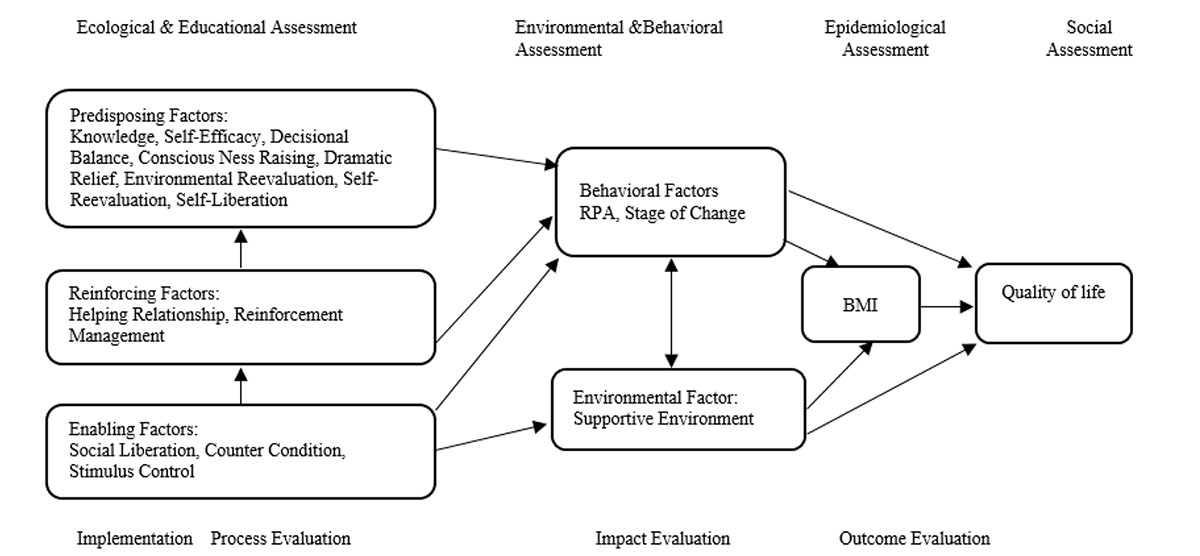
Figure 1.
Intervention model for preventing regular physical activity decline among 7th grade female students, designed in PRECEDE Framework combining with constructs of Trans-Theoretical Model
.
Intervention model for preventing regular physical activity decline among 7th grade female students, designed in PRECEDE Framework combining with constructs of Trans-Theoretical Model
In this study PRECEDE model was used for planning the intervention and TTM for educational assessment. Besides, to research team knowledge, in most previous studies, emphasis was on promoting RPA, while in this study preventing the age-related decline of RPA was considered as well.
This study aimed to determine the effect of educational program based on combining PRECEDE model and TTM for preventing PA decline in 7th grade girl students.
Methods
Participants
This randomized controlled trial was performed among 314 female students in 7th grade girl students in the city of Hamadan, west of Iran from October 2015 to May 2016. As diagnostic evaluation showed the deep decline in RPA in the 8th grade among female students
9
, to prevent it, the effective interventions needed to be implemented in seventh grade. The program implemented based on combining PRECEDE and TTM for 8 months.
Students participated in this study voluntarily. Informed consents were obtained before the study from both students and their parents or guardians. The study was approved by Ethics Committee of University of Hamadan Medical Sciences (number= 16-35-9-5301). In addition, this study is registered in Iran clinical trials registry (code=2015042921155N2).
To select the intervention and control groups, first, the two regions of Hamadan Education Department were divided randomly into intervention and control areas in order to prevent the dissemination of information. Second, in each region schools were divided into three categories (good, intermediate and inappropriate sport related facilities and places) using data from the Department of Education. Third, from each category, one school was selected randomly (3 schools as intervention and 3 schools as control groups) and from each school, two classes of seventh grade were randomly selected to participate in the program. The required sample size was 135 students for each group. On the other hand, in each school, 45 students were required, students’ number in classes was 25 to 33, and the intervention was not possible to be conducted outside of school hours. Therefore, two classes from each school were selected randomly. Thus, the sample size increased to 179 students for intervention group and 165 students for control group. A number of 15 students in the intervention group and 15 students in the control group were excluded based on inclusion and exclusion criteria. Finally, 150 students in the control group and 164 students in the intervention group participated in the study.
Inclusion criteria included seventh grade school girls in Hamadan, volunteered to participate in the study, the agreement of the parents and having no injury or illness that prevents PA, respectively. Exclusion criteria included not attending in the class and intervention programs, did not complete the questionnaire and migration. Figure 2 shows the flow chart of sampling procedure in this interventional study.
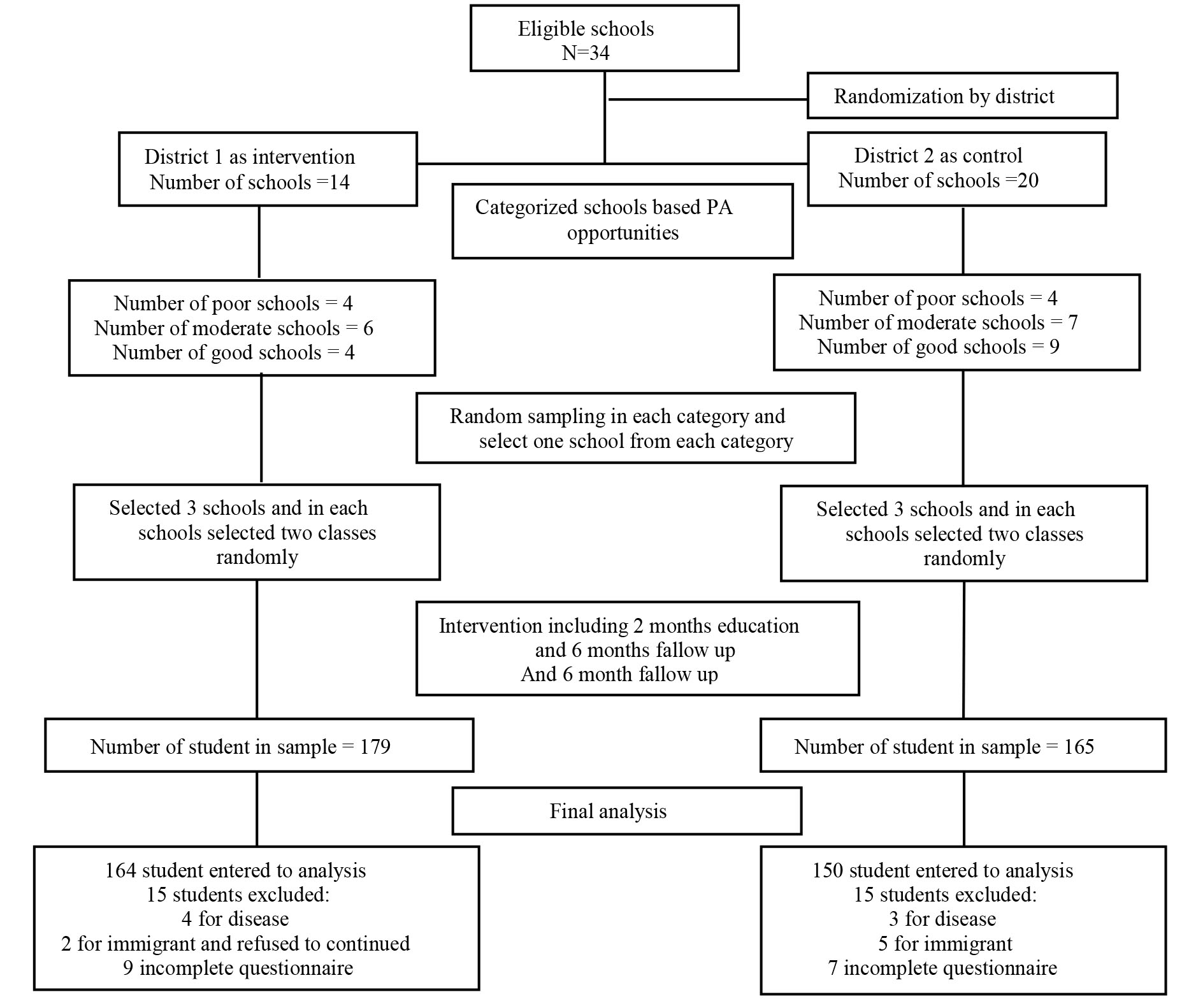
Figure 2.
Flow chart of sampling procedure for the interventional study
.
Flow chart of sampling procedure for the interventional study
Measures
Three questionnaires were used to collect data as follows:
simple
-
A. Demographic questionnaire, containing questions in
terms of parents’ jobs, parents' educational level, pubertal
status, membership in a sports club and household income.
-
B. The PA questionnaire for adolescent (PAQ_A) was used to assess PA
24
. PAQ_A is a self-reported about previous week PA recall. It contains nine questions starting with a checklist of last week sports (“no”, “1-2”, “3-4”, “5-6”, “7 or more times”), questions 2-7 asking about how often adolescents were active during physical education class, lunchtime, after school, evenings, weekend, describe their best and how often they were active in each day of their last week. Each question of PAQ_A has five choices in 5-point Likert scale (e.g., “never”, “hardly ever”, “sometimes”, quite often “and “always”). The final question requests if anything banned the adolescents to perform their usual PAs (“yes”, “no”). Total score is calculated as mean score of questions in which higher scores indicate higher PA levels. Previous studies have shown internal consistency (α = 0.79 to 0.89)
25
, and validity (rho= 0.47 for total PA and rho = 0.49 for MVPA) with spearman correlation between PAQ-A and accelerometer
26
.
-
C. TTM based questionnaires contain 45 questions used for educational assessment of PRECEDE model
21, 27, 28
. Stage of change (SOC) asks with 5 statements that students select one of the stages describing their present MVPA as an hour a day so that heart rate goes up and breathing becomes a little difficult as follows: I performed RPA more than 6 months (maintenance), I performed RPA less than 6 months (action), I intend to perform RPA within next month (preparation), I intend to perform RPA within 6 months (contemplation), I do not intend to engage in RPA within 6 months (pre-contemplation)
21
.
Self-efficacy measured by 6 questions in 5-point Likert scale ranging from completely confident (5 points) to not at all confident (1 point), how confident you are to perform RPA in certain circumstances for example when you spend time with your friends
21
, decisional balance is measured by 10 items (5 item for pros and five item for cons) in 5-point Likert scale ranging from extremely important to not important which means students defined the importance of each statement for decision making on exercising or not
28
and processes of change questionnaire include 10 process in 5-point Likert scale ranging from always (5 points) to never (one point)
27
. Processes of consciousness raising (3 questions), dramatic relief (3 questions), environmental re-evaluation (2 questions), self-reevaluation (3 questions) and self-liberation (3 questions) were questioned as predisposing factors. Processes of stimulus control (2 questions), counter condition (3 questions) and social liberation (3 questions) as enabling factors and processes of reinforcing management (3 questions) and helping relationships (2 questions) as reinforcing factors were questioned. Also, based on literature review 11 questions were produced by researchers to assess knowledge about PA. Each correct answer scored one and wrong answer scored zero. Face validity, content validity with 10 expert (CVI & CVR˃0.80) and confirmatory factor analysis (χ2= 1726.35, df =850 χ2/df=2.03, RMSEA=0.000) had been assessed in previous cross-sectional study in diagnostic evaluation
9
. Reliability was assessed by internal consistency (α=0.71) on 30 students who were non-participants in this study.
Students’ height and weight were measured by a digital scale and a stadiometer before and at the end of the study by the first researcher. Body Mass Index (BMI) was calculated for each students (kg/m2) and BMI Z-score was considered from WHO growth chart data.
Intervention program
As the educational assessment phase of PRECEDE model, revealed to be effective predisposing, enabling, and reinforcing factors in performing RPA in adolescents, the training program based on PRECEDE and TTM was planned and implemented in this study. The program included 1 hour training per week for 2 months (8 hours, totally) in the field of physical activity pyramid, the importance and benefits of adequate PA, issues and problems of inactivity and insufficient PA, how to do proper exercise and daily PA schedule. Methods used were lecture, group discussion, poster (physical activity pyramid) and pamphlets (the importance, benefits and how to perform aerobic activity, stretching and strengthening), a daily log book for documenting PA, practical training sessions for aerobic activities, stretching and strengthening muscles based on the objectives of the program by a trained coach in school (predisposing and enabling factors). Friendship teams were formed to walk to school. Exhibition of PA (wall newspapers and handcrafts) was held. Workout CD and sport oriented music was used (reinforcing and enabling factors) in the 8th educational session. After that, the reminder bracelets with the sports sign and the word "be active” were distributed among students as a reminder and commitment improver for RPA (self-liberation). In addition, the logbooks of PA were checked by principal researcher, each week for about 6 months, and students’ problems were solved and they were encouraged during this period.
Separately, for teachers, school staffs and students’ parents as reinforcing agents who affect students’ living environment (create supportive environments); two educating sessions were held. Educational content included importance of teenagers RPA and supporting them, duration and the way of performing RPA. In addition, special pamphlet for parents was sent to them through students and all pamphlets for staffs studying were placed in the school office. PA related banner with content of 60 min moderate to vigorous daily PA was installed as a reminder and for changing the environment to persuade students to do RPA in the hallway of the schools in intervention group. The students were followed for 6 months and then both groups completed questionnaires again. Regarding ethical considerations, after the completion of the study, the control group received educational materials and one session of education.
Data analysis
The data of 314 students were analyzed finally (164 in intervention and 150 in control group). Statistical analyses were performed with IBM statistic, SPSS version 20 (SPSS Inc., Chicago, IL, USA). Comparability of baseline characteristics of study groups was assessed using chi-square. Analysis of Covariance (ANCOVA) was used for comparison between-group differences on outcomes (PA, BMI and constructs of TTM in educational diagnosis of PRECEDE model). We first examined if the intervention and the control group differed at baseline on any of the study variables. Chi square test was used for differences between the stages of change. In all analyses, the level of significance was set at P< 0.05.
Results
All of students had about 13 years old. Demographic details of participants are presented in Table 1. There were no significant differences between the two groups before intervention in terms of demographic characteristics. Additionally, at baseline, there were no differences in PA and BMI between two groups.
Table 1.
Distribution of frequency and percentage of basic variables in 7th grade female students in Hamadan
|
Variables
|
Intervention
|
Control
|
P
value
|
|
Number
|
Percent
|
Number
|
Percent
|
| Mother education |
|
|
|
|
0.341 |
| Up to diploma |
84 |
54.5 |
87 |
60.0 |
|
| ≤12 yr |
70 |
45.5 |
58 |
40.0 |
|
| Father education |
|
|
|
|
0.863 |
| Up to diploma |
83 |
54.2 |
79 |
55.2 |
|
| ≤12 yr |
70 |
45.8 |
64 |
44.8 |
|
| Father job |
|
|
|
|
0.370 |
| Self-employment |
89 |
55.6 |
88 |
61.1 |
|
| Employment |
42 |
26.3 |
28 |
19.4 |
|
| Worker |
29 |
18.1 |
28 |
19.4 |
|
| Mother job |
|
|
|
|
0.342 |
| Employment |
27 |
16.5 |
19 |
12.7 |
|
| Unemployment |
137 |
83.5 |
131 |
87.3 |
|
| Puberty statue |
|
|
|
|
0.604 |
| Thelarche |
4 |
2.5 |
6 |
4.0 |
|
| Pubarche |
44 |
27.2 |
45 |
30.0 |
|
| Menarche |
114 |
70.4 |
99 |
66.0 |
|
| Being member of sports team |
|
|
|
|
0.114 |
| Yes |
32 |
19.8 |
41 |
27.3 |
|
| No |
130 |
80.2 |
109 |
72.7 |
|
| Family economic statue |
|
|
|
|
0.229 |
| low |
21 |
14.4 |
10 |
7.9 |
|
| Moderate |
61 |
41.8 |
64 |
50.8 |
|
| Good |
55 |
37.7 |
42 |
33.3 |
|
| Excellent |
9 |
6.2 |
10 |
7.9 |
|
Considering educational program, Table 2 shows the details of mean score and standard deviation and significant levels in predisposing, enabling, and reinforcing factors by TTM constructs in both groups. After educational intervention, ANCOVA analysis revealed that mean scores in the intervention group were significantly different from those in the control group in all constructs except cons. BMI in intervention group had no differences after intervention but in control group it raised and BMI increase was significant (P-value=0.002). RPA significantly increased in intervention group and therefore, the mean score differences between two groups were significant (P-value<0.001).
Table 2.
Predisposing, Reinforcing and Enabling Factors, Physical Activity and Body Mass Index among the students before and after the Intervention in the Intervention and Control Groups
|
Variables
|
Intervention
|
Control
|
P
value
|
|
Before
|
After
|
Before
|
After
|
|
Mean
|
SD
|
Mean
|
SD
|
Mean
|
SD
|
Mean
|
SD
|
| Predisposing factors |
|
|
|
|
|
|
|
|
|
| Pros |
4.14 |
0.76 |
4.43 |
0.60 |
4.26 |
0.73 |
4.23 |
0.81 |
0.001 |
| Cons |
2.90 |
0.77 |
2.74 |
0.94 |
2.84 |
0.85 |
2.78 |
0.82 |
0.336 |
| Self-efficacy |
3.04 |
0.88 |
3.90 |
0.84 |
3.09 |
0.92 |
3.01 |
0.90 |
0.001 |
| Consciousness raising |
3.54 |
1.02 |
3.98 |
0.97 |
3.82 |
1.03 |
3.79 |
1.01 |
0.002 |
| Dramatic relief |
3.82 |
1.07 |
4.09 |
0.93 |
3.60 |
1.16 |
3.65 |
1.10 |
0.001 |
| Environment reevaluation |
3.87 |
1.16 |
4.22 |
0.88 |
3.81 |
1.14 |
3.95 |
1.15 |
0.001 |
| Self-reevaluation |
4.47 |
0.79 |
4.42 |
0.80 |
4.48 |
0.82 |
4.22 |
0.95 |
0.010 |
| Self-liberation |
3.95 |
0.92 |
4.20 |
0.85 |
4.21 |
1.02 |
3.95 |
0.88 |
0.001 |
| Knowledge |
4.33 |
1.90 |
5.60 |
1.60 |
4.59 |
2.11 |
4.48 |
2.17 |
0.001 |
| Reinforcing factors |
|
|
|
|
|
|
|
|
|
| Helping relationship |
3.25 |
1.28 |
3.82 |
1.15 |
3.62 |
1.32 |
3.40 |
1.33 |
0.001 |
| Reinforcing management |
4.25 |
0.84 |
4.35 |
0.79 |
4.23 |
0.89 |
4.12 |
0.99 |
0.003 |
| Enabling factors |
|
|
|
|
|
|
|
|
|
| Counter condition |
3.15 |
1.14 |
3.81 |
1.03 |
3.35 |
1.11 |
3.29 |
1.21 |
0.001 |
| Social liberation |
3.94 |
0.86 |
4.19 |
0.77 |
4.08 |
0.89 |
3.96 |
1.01 |
0.022 |
| Stimulus control |
4.17 |
1.13 |
4.20 |
1.01 |
4.05 |
1.22 |
3.84 |
1.35 |
0.025 |
| Behavioral factor |
|
|
|
|
|
|
|
|
|
| Physical activity |
2.50 |
0.60 |
3.17 |
0.64 |
2.48 |
0.60 |
2.49 |
0.69 |
0.001 |
| Epidemiologic diagnosis |
|
|
|
|
|
|
|
|
|
| Body mass index |
19.02 |
4.15 |
19.14 |
4.06 |
19.97 |
3.88 |
20.53 |
3.93 |
0.002 |
Before the intervention, there were no differences between two groups in SOC. Distribution of SOC before and after intervention showed that indicates shifted to higher level for performing 60 min moderate to vigorous physical activity (MVPA) in intervention group (Table 3). Most of students were at action and maintenance stages (N=97; 59.2%). Before the intervention, 26 students (15.9%) were at the pre-contemplation and contemplation stages but after intervention, they decreased to 13 students (7.9%). Inversely in control group, students who were at the pre-contemplation and contemplation staged 23 students (22.4%) before the intervention increased to 47 students (31.3%) after the intervention.
Table 3.
Stage of change and physical activity mean score before and after the intervention between intervention and control groups
|
Stage of change
|
Intervention
|
Control
|
P
value
|
|
Before
|
After
|
Before
|
After
|
| Pre action, n (%) |
89 (54.30) |
67 (40.80) |
76 (51.70) |
95 (63.30) |
0.001 |
| Action, n (%) |
75 (45.70) |
97 (59.20) |
71 (48.30) |
55 (36.70) |
0.001 |
| Pre-action, mean (SD) PA |
2.37 (0.61) |
3.09 (0.58) |
2.25 (0.48) |
2.31 (0.68) |
0.001 |
| Action, mean (SD) PA |
2.65 (0.55) |
3.26 (0.58) |
2.72 (0.62) |
2.68 (0.68) |
0.001 |
Pre action (Pre-contemplation, Contemplation, Preparation); Action (Action, Maintenance); PA (physical activity); SD (standard deviation)
Discussion
Before the study, the two groups in terms of demographic variables, model structures, mean score of PA and body mass index were not significantly different. The results of this study showed that the developing and implementing educational programs in accordance with PRECEDE model and TTM, produced a significant difference in the scores of predisposing, enabling and reinforcing factors and increased behavior of RPA among female students in the intervention group. In this study, after the intervention, scores of knowledge as a predisposing factor in the intervention group in comparison to the control group was increased. This result is consistent with previous studies
29, 30
. Knowledge predicts PA
31
. Respectively, self-efficacy as predisposing factor, helping relationships and strengthen management as reinforcing factors were increased. The influence of social support and self-efficacy has been shown in regular PA
32
. Same as this study, previous study on 11-yr-old teenagers
32
suggests that social support from teachers (Reinforcing factors) and increased self-efficacy result in increasing PA (predisposing factors). Parents and teachers can be a role model and a source of social support for increasing PA in female adolescent. Raising awareness, verbal persuasion, goal setting, recording daily activities, skills training and doing PA, systematic strategies, were used to form and improve self-efficacy. Some studies have shown social support and self-efficacy mediate and predict PApromotion,
33, 34
. The counter condition and stimulus control for PA in the intervention group in comparison to the control group also were improved after the implementation of educational intervention (enabling factors). Stimulus control was a significant mediator for adolescents' PA
35
. In this study, having a belief and commitment to PA (self-liberation) was significant. The difference between all processes of change for PA activity was significant after intervention. People use the processes of change for moving through SOC, such as self-liberation, reinforcement management, counter condition, stimulus control and helping relationship.
Set of interventions and changes based on combined model could change students’ behavior. Consequently, after the intervention, most students in the intervention group had reached the stage of action and maintenance and students in pre-contemplation, contemplation and preparation stages had been decreased. Contrary, students in the control group had been increased in pre-contemplation, contemplation and preparation stages and students in the maintenance stage had been decreased. In addition, a significant increase in mean score of PA score was observed. These results were consistent with Pops study
22
. In the present study, not only decline was prevented in the intervention group but also PA increased. Results of the school-based intervention regarding their effect on rate and duration of PA were different in previous studies, as the interventions in some studies were effective and in some of them were not effective
15
. Physical activity promotion can be attributed to environmental factors and social support in addition to individual factors. The school based interventions via access to the target group, the possibility of increasing hours of RPA or increasing the quality of physical education classes and providing relevant and diverse training sessions are effective strategies in increasing PA in adolescents. In addition to theoretical and practical training, improving the quality of physical education hours using trained coach besides to schools’ sport coach, keeping students active, encouraged and supporting them by researchers, teachers, parents and peers had a significant role to promote RPA
16
.
In this study, BMI was not significantly increased in the intervention group, while significantly increased in the control group. It could be resulted from the impact of the intervention to increase RPA among participants in intervention group. As PRECEDE model argues about the problems of epidemiological and social resources, body mass index as an epidemiological problem wasinvestigated in this study. Johnson and colleagues showed TTM effectiveness in weight control via PA, nutrition and mental stress during their 24-month investigation and observed a significant difference between intervention and control groups in promoting PA and weight control
36
. Kattelmann and colleagues study, using PRECEDE model, showed increasing intensive activity among women in the intervention group comparing the control group
37
.
This study in spite of the strengths of preventing decline in RPA and improving it, based on strong models, had some limitations including conducting among girls and cannot being used for comparisons between both sexes. In addition, self-reported questionnaires may lead to some overestimates and using observational tools such as Actigraph or pedometer is recommended for future studies.
As the policy making and practical implications, regarding effectiveness of the school-based intervention in this study, using such a theory-based interventional program on RPA can be recommended among students in the community level and consideration of predisposing factors (such as self-efficacy), enabling factors (such as social liberation) and reinforcing factors (such as involving teachers, school staff and parents) can be helpful.
Conclusions
Intervention, based on PRECEDE and TTM, not only could prevent decline in RPA, but also could improve it among studied female students. Although, the number of students who performed one hour of RPA (action and maintenance stages) increased in the intervention group of this study, but more programs are needed to achieve ideal goal (maintenance stage). The female students in seventh grade can follow recommended RPA for their health promotion.
Acknowledgements
The authors would like to thank all of the participants and schools’ personnel.
Conflict of interest statement
The authors declare there is no conflict of interest.
Funding
This study is derived from the PhD thesis, approved and financially supported by the Vice-Chancellor of Research and Technology, Hamadan University of Medical Sciences study (number: 9308063798).
Highlights
-
Regular physical activity is a key factor in female adolescent health .
-
Decline in physical activity occurs in adolescence period, which can prevent by appropriate intervention .
-
PRECEDE and Trans-Theoretical models can provide suitable intervention framework to improve physical activity and prevent its decline in female students.
References
- Hallal PC, Andersen LB, Bull FC, Guthold R, Haskell W, Ekelund U. Global physical activity levels: surveillance progress, pitfalls, and prospects. The lancet 2012; 380:247-57. [ Google Scholar]
- Kelsey MM, Zaepfel A, Bjornstad P, Nadeau KJ. Age-related consequences of childhood obesity. Gerontology 2014; 60(3):222-8. [ Google Scholar]
- Magnussen CG, Smith KJ, Juonala M. When to prevent cardiovascular disease? As early as possible: lessons from prospective cohorts beginning in childhood. Curr Opin Cardiol 2013; 28(5):561-8. [ Google Scholar]
- Janssen I, LeBlanc AG. Systematic review of the health benefits of physical activity and fitness in school-aged children and youth. Int J Behav Nutr Phys Act 2010; 7:40. [ Google Scholar]
- Ekelund U, Luan Ja, Sherar LB, Esliger DW, Griew P, Cooper A. Moderate to vigorous physical activity and sedentary time and cardiometabolic risk factors in children and adolescents. JAMA 2012; 307(2):704-12. [ Google Scholar]
- Engelberg JK, Carlson JA, Conway TL, Cain KL, Saelens BE, Glanz K. Dog walking among adolescents: Correlates and contribution to physical activity. Prev Med 2016; 82:65-72. [ Google Scholar]
- Kelishadi R, Heshmat R, Motlagh ME, Majdzadeh R, Keramatian K, Qorbani M. Methodology and early findings of the third survey of CASPIAN Study: a national school-based surveillance of students' high risk behaviors. Int J Prev Med 2012; 3(6):394-401. [ Google Scholar]
- Telama R. Tracking of physical activity from childhood to adulthood: a review. Obesity Facts 2009; 2(3):187-95. [ Google Scholar]
-
Rostami-Moez M, Hazavehei S, Karami M, Karimi-Shahanjarini A, Nazem F, Rezapur-Shahkolai F. Decline in Physical Activity among Iranian Girl Students Aged 10 to 16 and the Related Factors. Health Scope. [In press].
- Eather N, Morgan PJ, Lubans DR. Social support from teachers mediates physical activity behavior change in children participating in the Fit-4-Fun intervention. Int J Behav Nutr Phys Act 2013; 10:68. [ Google Scholar]
- Lisón JF, Real-Montes JM, Torró I, Arguisuelas MD, Álvarez-Pitti J, Martínez-Gramage J. Exercise intervention in childhood obesity: a randomized controlled trial comparing hospital-versus home-based groups. Acad Pediatr 2012; 12(4):319-25. [ Google Scholar]
- Oreskovic NM, Winickoff JP, Perrin JM, Robinson AI, Goodman E. A multimodal counseling-based adolescent physical activity intervention. J Adolesc Health 2016; 59(3):332-7. [ Google Scholar]
-
Glanz K, Rimer BK, Viswanath K. Health behavior and health education: theory, research, and practice: John Wiley & Sons; 2008.
-
Green L, Kreuter M. Health program planning: an educational and ecological approach. 2005. NY: McGraw-Hill Higher Education. 2015.
- Dobbins M, Husson H, DeCorby K, LaRocca RL. School-based physical activity programs for promoting physical activity and fitness in children and adolescents aged 6 to 18. Cochrane Database Syst Rev 2013(2):CD007651.
- Heath GW, Parra DC, Sarmiento OL, Andersen LB, Owen N, Goenka S. Evidence-based intervention in physical activity: lessons from around the world. The lancet 2012; 380:272-81. [ Google Scholar]
- Meyer U, Ernst D, Zahner L, Schindler C, Puder JJ, Kraenzlin M. 3-Year follow-up results of bone mineral content and density after a school-based physical activity randomized intervention trial. Bone 2013; 55:16-22. [ Google Scholar]
- Rezapour B, Mostafavi F, Khalkhali HR. School-Based and PRECEDE-PROCEED-Model Intervention to Promote Physical Activity in the High School Students: Case Study of Iran. Glob J Health Sci 2016; 8(9):54497. [ Google Scholar]
- Rezapur-Shahkolai F, Afshari M, Moghimbeigi A, Hazavehei SMM. Home-related injuries among under-five-year children and mothers' care regarding injury prevention in rural areas. Int J Inj Contr Saf Promot 2016:1-9.
- Prochaska JO, DiClemente CC. The transtheoretical approach. Handbook of psychotherapy integration 2005; 2:147-71. [ Google Scholar]
- Marcus BH, Selby VC, Niaura RS, Rossi JS. Self-efficacy and the stages of exercise behavior change. Res Q Exerc Sport 1992; 63:60-6. [ Google Scholar]
- Pope ZC, Lewis BA, Gao Z. Using the Transtheoretical Model to Examine the Effects of Exergaming on Physical Activity Among Children. J Phys Act Health 2015; 12(9):1205-12. [ Google Scholar]
- Vahedian M, Alinia A, Attarzadeh R, Esmaeeli H. Assessment of Physical Activity Among Female Students of Tonekabon-Iran Based on Trans-theoretical Model. Thrita 2012; 2:127-32. [ Google Scholar]
-
Kowalski KC, Crocker PR, Donen RM. The physical activity questionnaire for older children (PAQ-C) and adolescents (PAQ-A) manual. College of Kinesiology, University of Saskatchewan. Saskatoon, SK, Canada. 2004.
- Crocker P, Bailey DA, Faulkner RA, Kowalski KC, McGRATH R. Measuring general levels of physical activity: preliminary evidence for the Physical Activity Questionnaire for Older Children. Med Sci Sports Exerc 1997; 29:1344-9. [ Google Scholar]
- Janz KF, Lutuchy EM, Wenthe P, Levy SM. Measuring activity in children and adolescents using self-report: PAQ-C and PAQ-A. Med Sci Sports Exerc 2008; 40(4):767-72. [ Google Scholar]
- Nigg C, Norman G, Rossi J, Benisovich S. Processes of exercise behavior change: Redeveloping the scale. Ann Behav Med 1999; 21:S79. [ Google Scholar]
- Nigg C, Rossi J, Norman G, Benisovich S. Structure of decisional balance for exercise adoption. Ann Behav Med 1998; 20:S211. [ Google Scholar]
- Estebsari F, Shojaeizadeh D, Mostafaei D, Farahbakhsh M. Planning and evaluation of an educational program based on precede model to improve physical activity in female students. Hayat 2010; 16:48-54. [ Google Scholar]
- Lytle LA, Murray DM, Evenson KR, Moody J, Pratt CA, Metcalfe L. Mediators affecting girls’ levels of physical activity outside of school: findings from the trial of activity in adolescent girls. Ann Behav Med 2009; 38:124-36. [ Google Scholar]
- Emdadi S, Hazavehie SMM, Soltanian A, Bashirian S, Heidari Moghadam R. Predictive Factors of Regular Physical Activity among Middle-Aged Women in the West of Iran, Hamadan: Application of PRECEDE Model. J Res Health Sci 2015; 15:244-9. [ Google Scholar]
- Bergh IH, Bjelland M, Grydeland M, Lien N, Andersen LF, Klepp K-I. Mid-way and post-intervention effects on potential determinants of physical activity and sedentary behavior, results of the HEIA study-a multi-component school-based randomized trial. Int J Behav Nutr Phys Act 2012; 9:1. [ Google Scholar]
- Plotnikoff RC, Costigan SA, Karunamuni N, Lubans DR. Social cognitive theories used to explain physical activity behavior in adolescents: a systematic review and meta-analysis. Prev Med 2013; 56:245-53. [ Google Scholar]
- Ardestani M, Niknami S, Hidarnia A, Hajizadeh E. Predictors of Physical Activity among Adolescent Girl Students Based on the Social Cognitive Theory. J Res Health Sci 2015; 15:223-7. [ Google Scholar]
- Taymoori P, Niknami S, Berry T, Lubans D, Ghofranipour F, Kazemnejad A. A school-based randomized controlled trial to improve physical activity among Iranian high school girls. Int J Behav Nutr Phys Act 2008; 5:1. [ Google Scholar]
- Johnson SS, Paiva AL, Cummins CO, Johnson JL, Dyment SJ, Wright JA. Transtheoretical model-based multiple behavior intervention for weight management: effectiveness on a population basis. Prev Med 2008; 46:238-46. [ Google Scholar]
- Kattelmann KK, Bredbenner CB, White AA, Greene GW, Hoerr SL, Kidd T. The effects of Young Adults Eating and Active for Health (YEAH): a theory-based Web-delivered intervention. J Nutr Educ Behav 2014; 46:S27-S41. [ Google Scholar]