J Res Health Sci.17(2) :e00383.
Review Article
Association between Catechol-O-Methyltransferase Val158Met (158G/A) Polymorphism and Suicide Susceptibility: A Meta-analysis
Tahereh Sadeghiyeh 1, Fatemeh Hosseini Biouki 1, Mahta Mazaheri 2, 3, Masoud ZareShehneh 2, Hossein Neamatzadeh 2, 3, Zahra Poursharif 1, *
Author information:
1 Department of Psychology, School of Medicine, Shahid Sadoughi University of Medical Sciences, Yazd, Iran
2 Department of Medical Genetics, School of Medicine, Shahid Sadoughi University of Medical Sciences, Yazd, Iran
3 Mother and Newborn Health Research Center, School of Medicine, Shahid Sadoughi University of Medical Sciences, Yazd, Iran
Abstract
Background: Common functional Val158Met polymorphism in the Catechol-O-methyltransferase
(COMT) gene may have an impact on an individual’s susceptibility to suicide, but individually published
results are inconclusive. Therefore, we performed this meta-analysis to provide a more precise
estimation of the association between COMT 158G/A (COMT Val158Met) polymorphism and suicide
susceptibility.
Study design:
A cross-sectional study.
Methods: This systematic review and meta-analysis is a comprehensive literature search of PubMed,
Scopus, Web of Science and Google Scholar databases was conducted on case-control studies
published up to Mar 2017. Crude odds ratios (ORs) with 95% confidence intervals (CIs) were
calculated.
Results: We identified 14 eligible case-control studies, including 2353 suicide attempters and 2593
controls. The pooled results indicated that COMT 158G/A (COMT Val158Met) polymorphism was not
significantly associated with increased overall suicide risk. The same results were revealed based on
ethnicity, Hardy–Weinberg equilibrium (HWE) status and genotyping technique. However, there was
significant association between COMT Val158Met polymorphism and suicide risk among females
under the homozygote (AA vs. GG: OR=1.829, 95% CI=1.158-2.889, P=0.010) and recessive (AA vs.
AG +GG: OR = 1.787, 95% CI=1.195, 2.671, P=0.005) models, but not among males.
Conclusions: COMT 158G/A (COMT Val158Met) polymorphism was associated with suicide
susceptibility only in females.
Keywords: Suicide, Catechol-O-methyltransferase, Genetic association, Meta-analysis, Susceptibility
Copyright and License Information
© 2017 The Author(s)
Citation: Sadeghiyeh T, Hosseini Biouki F, Mazaheri M, Zare-Shehneh M,Neamatzadeh H, Poursharif Z. Association between Catechol-O-Methyltransferase
Val158Met (158G/A) Polymorphism and Suicide Susceptibility: A Meta-analysis. J Res Health Sci. 2017; 17(2): e00383.
Introduction
Suicidal behavioris one of the main public health problems worldwide, which include a wide spectrum of self-destructive actions
1
. Approximately, one million people die by suicide each year worldwide. With a prevalence rate of 0.0145% and suicide accounting for 1.5% of death by all causes, it is the 10th leading cause of mortality worldwide
2
. The etiology of suicide due to a combined effect of genetic and external factors is not known exactly
3
. Social factors alone cannot fully explain suicidal behavior. However, some studies have indicated a strong genetic component to susceptibility to suicidal behavior
4
.
Catechol-O-methyltransferase (COMT) is an enzyme metabolizing noradrenaline in the synaptic cleft
5
. Association studies of dopamine receptor genes and COMT in schizophrenia and/or ADHD subjects report genetic associations with various domains of cognitive function, including executive function, verbal and working memory, attention, and performance monitoring. Therefore, it was suggested that COMT could also play a role in the susceptibility to suicidal behavior
6, 7
. The COMT gene has a common functional polymorphism, val158met (rs4680) variant
8, 9
. This polymorphism is due to a G to A transition at codon 158 of the membrane-bound form of COMT, which corresponds to codon 108 of the soluble form of COMT, resulting in a valine (Val) to methionine (Met) substitution
9
.
The genetic component of suicidal behaviorwas originally founded by family, adoption and twin studies. Its heritability is in the range between 30%–55%
10, 11
. A family history of suicide is a strong risk factor for suicide and suicide attempt
11
. The COMT gene is located on the long arm of chromosome 22 at 22q11; spans 28 kb and contains six exons
9
. The function of COMT polymorphism in several psychotic conditions, such as schizophrenia, bipolar disorder, major depressive disorder, obsessive-compulsive disorder, and Parkinson’s disease, and the putative effects of COMT on suicide have been proposed
12, 13
.
Several case-control studies have reported the association between COMT polymorphism and suicide susceptibility
8, 9, 18, 29
, but the results are inconclusive partially because of the possible small effect of the polymorphism on suicide risk and the small sample in some published study. Therefore, we performed a meta-analysis to derive a precise estimate of this association.
Methods
Publication Search
We searched the electronic PubMed, Scopus, Web of Knowledge, and Google scholar database to identify all case–control studies examined the association between COMT Val158Met (158G/A) polymorphism and suicide risk up to Mar 2017. The keywords were as follows: ‘’Catechol-O-methyltransferase’’, ‘’COMT gene’’, ‘’COMT Val158Met’’, ‘’COMT 158G/A’’, ‘’rs4680’’, ‘‘polymorphism’’, ‘‘genotype’’, ‘‘variant’’, ‘’mutation’’, suicide’’, and ‘’suicide behavior’’. Additionally, reference lists of the relevant case-control studies, review, and meta-analysis were reviewed manually to identify additional relevant studies.
Inclusion and Exclusion Criteria
Studies included in our meta-analysis had to meet all of the following criteria: 1) used case-control study or cohort study; 2) the studies evaluated the associations between the COMT Val158Met (158G/A) polymorphism and suicide risk; 3) studies published in English and Persian; and provided sufficient information for calculation of odds ratio (ORs) with 95% confidence interval (CI). Accordingly, the following exclusion criteria were also considered: 1) those studies that were not designed as case-control or cohort studies; 2) control population including suicide attempter or other similar conditions; 3) there was no available genotype or allele frequency; 4) duplicate of previous publication; and 5) studies not written in English or Persian. Moreover, if multiple studies from the same case series were available, the one including the more individuals was used in the analysis.
Data Extraction
Information was carefully extracted from all eligible publications independently by two investigators according to the inclusion criteria listed above and data with discrepancies in identification were discussed by all authors. For each included study, the following information was collected: first author’s name, year of publication, country of origin, total number of cases and controls, distribution of genotypes and alleles, minor allele frequencies (MAFs), and P-value for Hardy–Weinberg equilibrium (HWE). The countries of origin were categorized as Asian, Caucasian, and African.
Statistical Analysis
The associations between the COMT Val158Met (158G/A) polymorphism and suicide were measured by odds ratios (OR) with 95% confidence intervals (CI) under the allele model (A vs. G), the homozygote model (AA vs. GG), the heterozygote model (AG vs. GG), the dominant model (AA+AG vs. GG), and the recessive model (AA vs. AG +GG). The heterogeneity assumption was checked by the Q-statistics with P-values < 0.1, and I
2
statistics was calculated to quantify the proportion of the total variation across studies due to heterogeneity
14
. I
2
values of 25%, 50%, and 75% were nominally assigned as low, moderate, and high estimates, respectively. When heterogeneity was considered significant, the random-effects model (DerSimonian- Laird approach) was performed. Otherwise, the fixed-effects model (Mantel-Haenszel approach) was used
15
. The departure from the Hardy–Weinberg equilibrium (HWE) for the control group in each study was tested using an online HWE calculator. The HWE was considered statistically significant when the P-value was less than 0.05. Sensitivity analysis was also tested by removing one study at a time to calculate the overall homogeneity and effect size. Publication bias was evaluated by funnel plots and further assessed by Egger’s linear regression test
16, 17
. All the statistical analyses were performed by comprehensive meta-analysis (CMA) ver. 2.0 (Chicago, IL, USA) software (Biostat, USA). All the P values were 2-sided. P-value less than 0.05 was considered statistically significant.
Results
Characteristics of Studies
Thirty-seven publications fulfilled our search criteria were preliminarily were enrolled. After reading the titles and abstracts, 22 studies with duplicate titles, review, meta-analyses or focused on unrelated condition were excluded. One study was excluded because was not case–control. Finally, 14 case-control studies
8, 9, 18-29
, on COMT genotypes and suicide risk were identified, including a total of 2353 suicide attempters and 2593 controls from 2000 to 2016 (Table 1). All studies were published in English. Among them five studies were in North America (USA, Canada, and Mexico), five in Asia (Taipei, Japan, and North Korea), and six (Germany, Croatia, Slovenia, Finnish Switzerland and France) in Europe. The genotypes in the healthy control group for two studies were not consistent with HWE (P<0.05)
23, 29
. Table 2 summarizes the difference of genotypes and alleles frequency between males and females suicide attempters.
Table 1.
Main characteristics of studies included in this meta-analysis
|
First author
|
Country (Ethnicity)
|
Genotyping
technique
|
Case/
Control
|
Cases
|
Controls
|
MAFs
a
|
HWE
b
|
|
Genotypes
|
Allele
|
Genotypes
|
Allele
|
|
GG
|
AG
|
AA
|
G
|
A
|
GG
|
AG
|
AA
|
G
|
A
|
Ohara et al
1998
18
|
Japan
(Asian)
|
RFLP-PCR |
12/135 |
2 |
7 |
3 |
11 |
13 |
58 |
59 |
18 |
175 |
95 |
0.351 |
0.627 |
Nolan et al
2000
8
|
USA & Finnish
(Caucasian)
|
No available |
84/64 |
28 |
35 |
21 |
91 |
77 |
10 |
31 |
23 |
51 |
77 |
0.601 |
0.933 |
Russ et al
2000
19
|
USA
(Caucasian)
|
RFLP-PCR |
49/49 |
9 |
28 |
12 |
46 |
52 |
7 |
26 |
16 |
40 |
58 |
0.591 |
0.491 |
Liou et al
2001
20
|
Taipei
(Asian)
|
RFLP-PCR |
62/188 |
36 |
23 |
3 |
95 |
29 |
98 |
79 |
11 |
275 |
101 |
0.268 |
0.341 |
|
Rujescu et al 2003
21
|
Germany
(Caucasian)
|
RFLP-PCR |
149/328 |
35 |
69 |
45 |
139 |
159 |
78 |
167 |
83 |
323 |
333 |
0.507 |
0.737 |
Ono et al
2004
22
|
Japan
(Asian)
|
RFLP-PCR |
163/169 |
68 |
79 |
16 |
215 |
111 |
90 |
61 |
18 |
241 |
97 |
0.287 |
0.125 |
Baud et al
2007
23
|
Switzerland & France(Caucasian) |
RFLP-PCR |
427/185 |
124 |
218 |
85 |
466 |
388 |
34 |
107 |
44 |
175 |
195 |
0.527 |
0.029 |
|
Zalsman et al 2008
24
|
USA
(Caucasian)
|
RFLP-PCR |
200/119 |
34 |
114 |
53 |
106 |
294 |
27 |
67 |
25 |
121 |
117 |
0.491 |
0.168 |
Lee et al
2011
25
|
Korea
(Asian)
|
RFLP-PCR |
197/170 |
94 |
85 |
18 |
273 |
121 |
69 |
85 |
16 |
223 |
117 |
0.344 |
0.160 |
Pivac et al
2011
26
|
Slovenia
(Caucasian)
|
Sequencing |
356/198 |
78 |
197 |
81 |
353 |
359 |
45 |
97 |
56 |
187 |
209 |
0.527 |
0.809 |
Nedic et al
2011
27
|
Croatia
(Caucasian)
|
TaqMan |
82/311 |
9 |
38 |
35 |
56 |
108 |
76 |
170 |
65 |
322 |
300 |
0.482 |
0.095 |
TovillaZárate
et al 2011
9
|
México
(Mixed)
|
TaqMan |
105/236 |
34 |
58 |
13 |
126 |
84 |
80 |
112 |
44 |
272 |
200 |
0.423 |
0.664 |
Du et al
2014
28
|
Canada
(Caucasian)
|
RFLP-PCR |
98/72 |
16 |
19 |
14 |
51 |
47 |
22 |
30 |
20 |
74 |
70 |
0.486 |
0.158 |
Sun et al.
2016
29
|
China
(Asian)
|
LCRc
|
369/369 |
218 |
129 |
22 |
565 |
173 |
193 |
161 |
15 |
547 |
191 |
0.258 |
0.008 |
aMinor allele frequencies, bHardy–Weinberg equilibrium, cLigase chain reaction (LCR).
Table 2.
Results of meta-analysis for the COMT Val158Met (158G/A) polymorphism and suicide risk
|
First author
|
Country (Ethnicity)
|
Case/
Control
|
Cases
|
MAFs
a
|
Controls
|
MAFs
a
|
HWE
b
|
|
Genotypes
|
Allele
|
Genotypes
|
Allele
|
|
GG
|
AG
|
AA
|
G
|
A
|
GG
|
AG
|
AA
|
G
|
A
|
|
Male Attempters
|
|
|
|
|
|
|
|
|
|
|
|
|
|
|
|
Ono et al 2004
22
|
Japan (Asian) |
112/114 |
43 |
60 |
9 |
146 |
78 |
0.348 |
62 |
42 |
10 |
166 |
62 |
0.271 |
0.457 |
|
Lee et al 2011
25
|
Korea (Asian) |
70/85 |
37 |
26 |
7 |
100 |
40 |
0.285 |
26 |
48 |
11 |
100 |
70 |
0.411 |
0.126 |
|
Pivac et al 2011
26
|
Slovenia(Caucasian) |
269/132 |
60 |
156 |
53 |
276 |
262 |
0.487 |
25 |
64 |
43 |
114 |
150 |
0.568 |
0.891 |
|
Nedic et al2011
27
|
Croatia (Caucasian) |
59/253 |
6 |
27 |
26 |
39 |
79 |
0.669 |
62 |
141 |
50 |
265 |
241 |
0.476 |
0.062 |
|
Du et al 2014
28
|
Canada (Caucasian) |
35/47 |
13 |
16 |
6 |
42 |
28 |
0.400 |
15 |
18 |
14 |
48 |
46 |
0.489 |
0.109 |
|
Sun et al.2016
29
|
China (Asian) |
117/117 |
70 |
40 |
7 |
180 |
54 |
0.230 |
64 |
46 |
7 |
174 |
60 |
0.256 |
0.737 |
| Total |
|
662/745 |
229 |
325 |
108 |
783 |
541 |
0.408 |
254 |
356 |
135 |
864 |
626 |
0.420 |
0.598 |
|
Female Attempters
|
|
|
|
|
|
|
|
|
|
|
|
|
|
|
|
Ono et al 2004
22
|
Japan (Asian) |
51/55 |
25 |
19 |
7 |
69 |
33 |
0.323 |
28 |
19 |
8 |
75 |
35 |
0.318 |
0.130 |
|
Lee et al 2011
25
|
Korea (Asian) |
127/85 |
57 |
59 |
11 |
173 |
81 |
0.318 |
43 |
37 |
5 |
123 |
47 |
0.276 |
0.416 |
|
Pivac et al 2011
26
|
Slovenia(Caucasian) |
87/66 |
18 |
41 |
28 |
77 |
97 |
0.557 |
20 |
33 |
13 |
73 |
59 |
0.447 |
0.926 |
|
Nedic et al 2011
27
|
Croatia (Caucasian) |
23/58 |
3 |
11 |
9 |
17 |
29 |
0.630 |
14 |
29 |
15 |
57 |
59 |
0.508 |
0.998 |
|
Du et al 2014
28
|
Canada (Caucasian) |
14/24 |
3 |
3 |
8 |
9 |
19 |
0.678 |
7 |
11 |
6 |
25 |
23 |
0.479 |
0.688 |
|
Sun et al. 2016
29
|
China (Asian) |
252/252 |
148 |
89 |
15 |
385 |
119 |
0.236 |
129 |
115 |
8 |
373 |
131 |
0.259 |
0.003 |
| Total |
|
554/540 |
254 |
222 |
78 |
730 |
378 |
0.341 |
241 |
244 |
55 |
726 |
354 |
0.327 |
0.555 |
aMinor allele frequencies, bHardy–Weinberg equilibrium
Pooled Analysis
Table 3 listed the main results of the meta-analysis of COMT Val158Met (158G/A) polymorphism and suicide risk. When all the eligible studies were pooled into the meta-analysis of COMT Val158Met (158G/A) polymorphism, there was no significantly increased risk of suicide under all genetic models (A vs. G: OR=1.089; 95% CI: 0.797, 1.488, P=0.592; AA vs. GG: OR=1.012; 95% CI: 0.726, 1.411, P= 0.943; AG vs. GG: OR=0.958; 95% CI: 0.762, 1.204, P= 0.714; AA+AG vs. GG: OR=0.889; 95% CI: 0.669, 1.182, P=0.419; and, AA vs. AG +GG: OR=0.980, 95% CI: 0.746, 1.286, P= 0.883).
Table 3.
Results of genetic comparisons for COMT 158 G/A (COMT Val158Met) polymorphism and suicide.
|
Genetic model
|
No. of studies
|
Model
|
Heterogeneity
|
Odds Ratio
|
Publication Bias
|
|
I
2
(%)
|
P
value
|
OR (95% CI)
|
P
value
|
P
Beggs
|
P
Eggers
|
|
Overall
|
|
|
|
|
|
|
|
|
| A vs. G |
14 |
Random |
91.00 |
0.001 |
1.089 (0.797, 1.488) |
0.592 |
0.273 |
0.696 |
| AA vs. GG |
14 |
Random |
61.17 |
0.001 |
1.012 (0.726, 1.411) |
0.943 |
0.381 |
0.558 |
| AG vs. GG |
14 |
Random |
55.72 |
0.006 |
0.958 (0.762, 1.204) |
0.714 |
0.443 |
0.315 |
| AA+AG vs. GG |
14 |
Random |
74.78 |
0.001 |
0.889 (0.669, 1.182) |
0.419 |
0.458 |
0.722 |
| AA vs. AG +GG |
14 |
Random |
61.05 |
0.001 |
0.980 (0.746, 1.286) |
0.883 |
0.742 |
0.784 |
|
Caucasian
|
|
|
|
|
|
|
|
|
| A vs. G |
8 |
Random |
92.04 |
0.001 |
0.962 (0.631, 1.467) |
0.858 |
0.901 |
0.750 |
| AA vs. GG |
8 |
Random |
75.49 |
0.001 |
1.014 (0.611, 1.682) |
0.958 |
0.901 |
0.877 |
| AG vs. GG |
8 |
Random |
53.24 |
0.036 |
0.916 (0.680, 1.234) |
0.566 |
0.901 |
0.993 |
| AA+AG vs. GG |
8 |
Random |
83.63 |
0.001 |
0.829 (0.492, 1.397) |
0.481 |
0.901 |
0.913 |
| AA vs. AG +GG |
8 |
Random |
75.56 |
0.001 |
0.957 (0.650, 1.409) |
0.824 |
0.901 |
0.573 |
|
Asian
|
|
|
|
|
|
|
|
|
| A vs. G |
5 |
Fixed |
51.18 |
0.085 |
0.966 (0.830, 1.124) |
0.652 |
0.086 |
0.294 |
| AA vs. GG |
5 |
Fixed |
0.00 |
0.424 |
1.051 (0.712, 1.550) |
0.803 |
0.086 |
0.239 |
| AG vs. GG |
5 |
Fixed |
0.00 |
0.450 |
0.871 (0.592, 1.282) |
0.483 |
0.806 |
0.890 |
| AA+AG vs. GG |
5 |
Random |
92.78 |
0.001 |
0.749 (0.311, 1.799) |
0.518 |
0.806 |
0.966 |
| AA vs. AG +GG |
5 |
Fixed |
0.00 |
0.687 |
1.135 (0.784, 1.644) |
0.502 |
1.000 |
0.763 |
|
Mixed
|
|
|
|
|
|
|
|
|
| A vs. G |
1 |
Fixed |
0.00 |
1.000 |
0.907 (0.651, 1.262) |
0.562 |
NAa
|
NAa
|
| AA vs. GG |
1 |
Fixed |
0.00 |
1.000 |
1.438 (0.688, 3.007) |
0.334 |
NAa
|
NAa
|
| AG vs. GG |
1 |
Fixed |
0.00 |
1.000 |
1.753 (0.875, 3.513) |
0.114 |
NAa
|
NAa
|
| AA+AG vs. GG |
1 |
Fixed |
0.00 |
1.000 |
1.071 (0.656, 1.747) |
0.784 |
NAa
|
NAa
|
| AA vs. AG +GG |
1 |
Fixed |
0.00 |
1.000 |
0.617 (0.317, 1.201) |
0.155 |
NAa
|
NAa
|
|
By HWE
b
|
|
|
|
|
|
|
|
|
| A vs. G |
12 |
Random |
91.57 |
0.001 |
1.150 (0.787, 1.681) |
0.470 |
0.450 |
0.872 |
| AA vs. GG |
12 |
Random |
59.34 |
0.005 |
1.065 (0.736, 1.541) |
0.738 |
0.731 |
0.886 |
| AG vs. GG |
12 |
Random |
40.93 |
0.068 |
1.067 (0.844, 1.348) |
0.588 |
0.837 |
0.934 |
| AA+AG vs. GG |
12 |
Random |
75.22 |
0.001 |
0.953 (0.678, 1.340) |
0.781 |
0.945 |
0.899 |
| AA vs. AG +GG |
12 |
Random |
64.30 |
0.001 |
0.964 (0.700, 1.328) |
0.824 |
0.537 |
0.568 |
aNot applicable, b Hardy–Weinberg equilibrium
Subgroup Analysis
Stratified analysis by ethnicity showed no association between COMT Val158Met (158G/A) polymorphism and suicide risk in the Caucasian, Asian and mixed populations. The same results were also revealed by HWE status (Table 3). Results of the stratified analysis studies for female and male attempters are summarized in Table 3. In the stratified analysis for male attempters, the data on genotypes of the COMT Val158Met (158G/A) polymorphism was available in six studies including 662 cases and 745 controls. However, the COMT Val158Met (158G/A) polymorphism was not significantly associated with suicide risk under all genetic models. For female attempters, the data on genotypes of the COMT Val158Met polymorphism was available in six studies including 554 cases and 540 controls. The COMT Val158Met (158G/A) polymorphism was associated with an increased the risk of suicide under the homozygote model (AA vs. GG: OR=1.829; 95% CI: 1.158, 2.889, P=0.010) and the recessive model (AA vs. AG +GG: OR=1.787; 95% CI: 1.195, 2.671, P=0.005) in females (Table 4). Additionally, there was no association between COMT Val158Met (158G/A) polymorphism and suicide risk by genotyping technique (Table 4).
Table 4.
Results of genetic comparisons for COMT 158 G/A (COMT Val158Met) polymorphism and suicide.
|
Genetic Model
|
No. of studies
|
Model
|
Heterogeneity
|
Odds ratio
|
Publication Bias
|
|
I
2
(%)
|
P
value
|
OR (95% CI)
|
P
value
|
P
Beggs
|
P
Eggers
|
|
By Gender
|
|
|
|
|
|
|
|
|
|
Male
|
|
|
|
|
|
|
|
|
| A vs. G |
6 |
Random |
82.42 |
0.001 |
0.972 (0.644, 1.468) |
0.894 |
1.000 |
0.931 |
| AA vs. GG |
6 |
Random |
74.37 |
0.002 |
0.950 (0.439, 2.059) |
0.898 |
1.000 |
0.624 |
| AG vs. GG |
6 |
Random |
70.08 |
0.005 |
1.028 (0.621, 1.702) |
0.913 |
0.707 |
0.993 |
| AA+AG vs. GG |
6 |
Random |
75.36 |
0.001 |
1.000 (0.591, 1.692) |
0.999 |
0.707 |
0.839 |
| AA vs. AG +GG |
6 |
Random |
79.31 |
0.001 |
0.923 (0.451, 1.889) |
0.827 |
1.000 |
0.987 |
|
Female
|
|
|
|
|
|
|
|
|
| A vs. G |
6 |
Fixed |
39.29 |
0.144 |
1.137 (0.943, 1.370) |
0.180 |
0.259 |
0.050 |
| AA vs. GG |
6 |
Fixed |
0.00 |
0.816 |
1.829 (1.158, 2.889) |
0.010 |
0.707 |
0.540 |
| AG vs. GG |
6 |
Fixed |
13.92 |
0.325 |
0.897 (0.690, 1.167) |
0.418 |
1.000 |
0.218 |
| AA+AG vs. GG |
6 |
Fixed |
27.38 |
0.229 |
0.996 (0.775, 1.280) |
0.977 |
0.707 |
0.053 |
| AA vs. AG +GG |
6 |
Fixed |
0.00 |
0.735 |
1.787 (1.195, 2.671) |
0.005 |
0.707 |
0.791 |
|
By Genotyping Technique
|
|
|
|
|
|
|
|
|
|
RFLP-PCR
|
|
|
|
|
|
|
|
|
| A vs. G |
9 |
Random |
93.20 |
0.001 |
1.169 (0.715, 1.911) |
0.534 |
0.348 |
0.842 |
| AA vs. GG |
9 |
Fixed |
34.53 |
0.142 |
0.954 (0.739, 1.231) |
0.716 |
0.916 |
0.460 |
| AG vs. GG |
9 |
Random |
54.08 |
0.026 |
0.959 (0.709, 1.296) |
0.784 |
0.465 |
0.438 |
| AA+AG vs. GG |
9 |
Random |
78.01 |
0.001 |
0.851 (0.566, 1.279) |
0.437 |
0.916 |
0.876 |
| AA vs. AG +GG |
9 |
Fixed |
21.66 |
0.250 |
0.962 (0.780, 1.187) |
0.720 |
0.602 |
0.740 |
|
TaqMan
|
|
|
|
|
|
|
|
|
| A vs. G |
2 |
Random |
90.89 |
0.001 |
1.366 (0.608, 3.067) |
0.450 |
NAa
|
NAa
|
| AA vs. GG |
2 |
Random |
91.21 |
0.001 |
1.765 (0.280, 11.120) |
0.545 |
NAa
|
NAa
|
| AG vs. GG |
2 |
Fixed |
0.00 |
0.356 |
1.391 (0.908, 2.132) |
0.129 |
NAa
|
NAa
|
| AA+AG vs. GG |
2 |
Random |
74.50 |
0.048 |
1.603 (0.669, 3.840) |
0.290 |
NAa
|
NAa
|
| AA vs. AG +GG |
2 |
Fixed |
91.98 |
0.001 |
1.339 (0.302, 5.933) |
0.701 |
NAa
|
NAa
|
Sensitivity Analysis
To evaluate the robustness of the association results, the meta-analysis was performed repeatedly with each study removed. No individual study significantly affected the pooled ORs. Sensitivity analysis was performed based on HWE, and the corresponding pooled ORs were not materially altered, indicating that our results were statistically robust.
Publication bias
Publication bias was qualitatively examined using the funnel plots and quantitatively estimated by Begg’s test and Egger’s test. For all genetic models, the shapes of the funnel plots did not reveal any evidence of obvious asymmetry (Figure 1). These results were further supported by analysis via Egger’s linear regression test (A vs. G: PBeggs= 0.273, PEggers= 0.696; AA vs. GG: PBeggs= 0.381, PEggers= 0.558; AG vs. GG: PBeggs= 0.443, PEggers= 0.315; AA+AG vs. GG: PBeggs= 0.458, PEggers= 0.722; and AA vs. AG +GG: PBeggs= 0.742, PEggers= 0.784, Table 1).
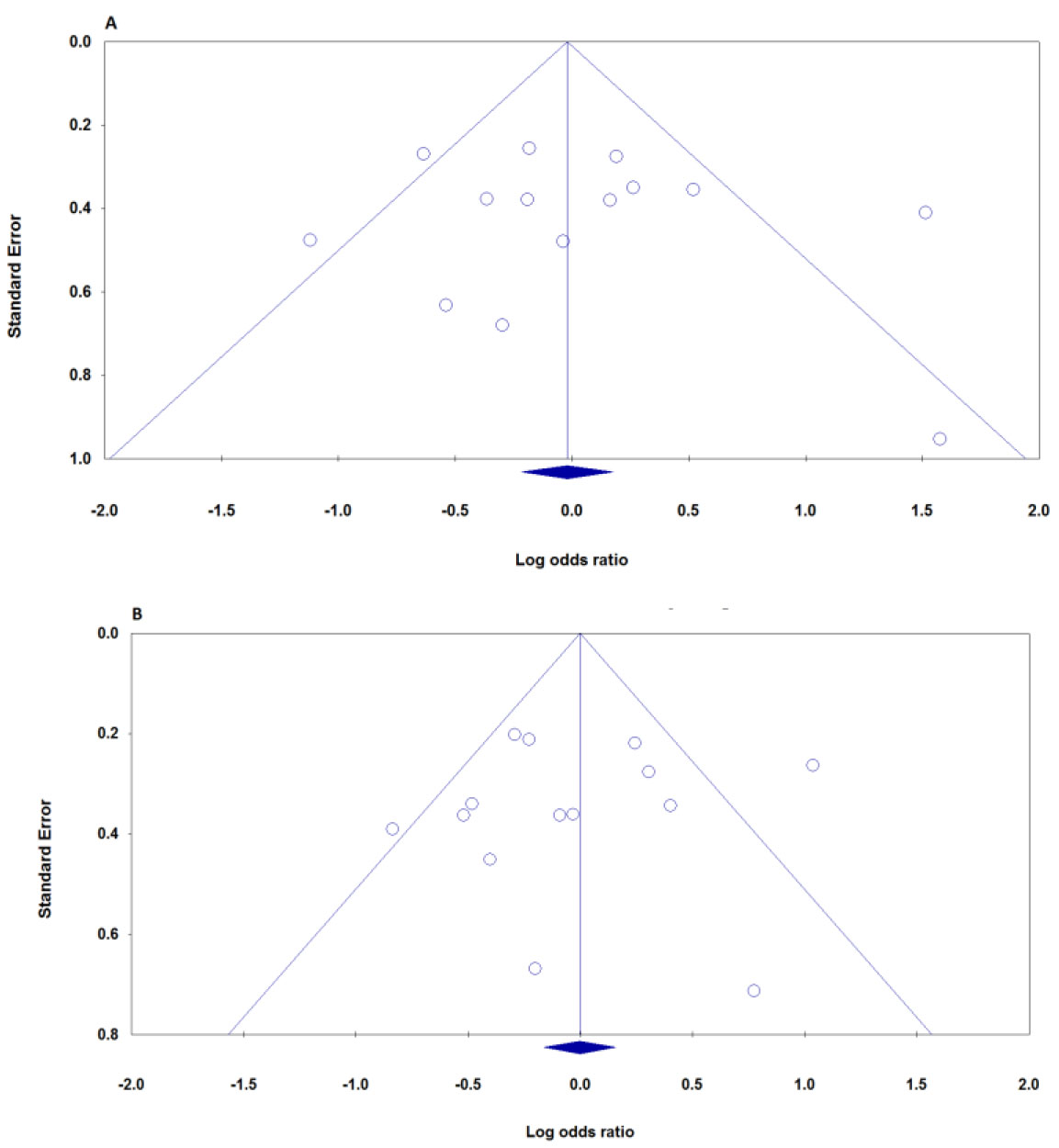
Figure 1.
Begg’s funnel plots of the COMT 158 G/A (COMT Val158Met) polymorphism and suicide risk for publication bias test. A: the homozygote model (AA vs. GG) and B: the recessive model (AA vs. AG +GG).
.
Begg’s funnel plots of the COMT 158 G/A (COMT Val158Met) polymorphism and suicide risk for publication bias test. A: the homozygote model (AA vs. GG) and B: the recessive model (AA vs. AG +GG).
Discussion
To date, the association between COMT Val158Met polymorphism and suicide remains controversial because the reports include both positive and negative findings
9, 30
. Several large studies in the USA, Germany, Slovenia, and Croatia suicide attempter cases found no evidence for an increased risk of suicide
21, 24, 26
. These epidemiological studies results are inconsistent because this association was found in presence of the COMT Met allele in the male and female suicide attempters and diagnosed with different mental and mood disorders such as schizophrenia and alcohol dependency.. These differences among studies might be explained by the different diagnostic entities used. Therefore, the main limitation could be that the genetic association studies on COMT 158G/A polymorphism have been performed in different ethnicity and may be different criteria have been applied in the studies to define suicidal behavior, which reduces power to find consistent results
21, 24, 31
.To the best knowledge, the present meta-analysis is the most comprehensive and accurate meta-analysis assessed the association between the COMT 158G/A (COMT Val158Met) polymorphism and suicide risk. Our results did not show any significant association between the COMT Val158Met polymorphism and suicide in overall. Several issues should be further discussed to address the negative results. However, for most 14 studies involved, when they were individually removed from the analysis, the association between COMT Val158Met polymorphism and suicidal behavior was not significant still. Thus, the evidence for an association between COMT and suicidal behavior was robust.
Our results were consistent with a more recent meta-analysis on COMT Val158Met and suicide risk. Eleven case–control studies and one case-only study were included on COMT Val158Met polymorphism
9
. COMT Val158Met polymorphism was not associated with suicidal behavior risk. However, COMT Val158Met and suicide risk essentially remain an open field, as meta-analysis study not selected healthy controls (with only 875 adult suicide attempters). Therefore, their results’ reliability and the number of studies are considerably smaller than that needed to receive the robust conclusions
32
. Moreover, compared with their meta-analysis, subgroup analysis by ethnicity and gender were also carried out. In our meta-analysis, the COMT Val158Met polymorphism was associated with suicide risk in females.
Interestingly, when all the eligible studies were pooled into male and gender subgroups analysis, only in female subgroup increased risk for suicide was found. However, there was an imbalance in gender distribution, with more males in attempters than females. None of the genetic models showed association with male susceptibility, suggesting that COMT 158G/A (COMT Val158Met) manifest female specific influences on suicide attempt. Estrogen in females modulates neurotransmission and neuronal excitability of catecholaminergic systems and increases the concentration of dopamine in the synaptic gap, leading to the different influence of dopamine on emotion and motivation among male and females
33,,34
. In addition, gender-related differences in suicide behavior might be due to the fact that COMT 158G/A (COMT Val158Met) polymorphism may differently influence personality traits that presumably affect suicide behavior
35, 36
. However, we were unable to conduct accurate more analyses of COMT polymorphisms by gender subgroup for insufficient data, thus the existence of gender-specific influences on suicide in this meta-analysis remains unclear. In this meta-analysis the female specificity in effect of the COMT 158G/A (COMT Val158Met) polymorphism on suicide attempt could be a chance finding, this result is inconsistent with gender differences in the dopamine system
37
. Further examination in the included eligible case-control studies in the gender subgroups showed significant differences between cases and controls numbers in male and female subgroups.
In interpreting results of this meta-analysis, some limitations should be acknowledged. First, not all the eligible studies were collected; the sample size of the included studies was large enough by ethnicity, especially in non-Caucasian and Asian populations. Therefore, there was a lack of statistical power to evaluate better the association between COMT 158G/A (COMT Val158Met) polymorphism and suicide, especially in subgroup analysis. Second, due to limited individual data, a more precise analysis on other covariates such as age, number of suicide attempts, and environmental factors were not performed. Third, since the genotypes frequency of COMT 158G/A polymorphism not mentioned by gender of suicide attempters in all studies, we only evaluated the eligible studies for gender subgroups. Finally, as suicide is a complex trait, gene-gene and gene-environment interactions were not analyzed. Specific environmental and lifestyle factors will alter the associations between gene polymorphisms and suicide susceptibility. Therefore, it is necessary to evaluate the roles of lifestyles in suicide.
Conclusions
The present meta-analysis is the most comprehensive and accurate meta-analysis assessed the association between the COMT 158G/A (COMT Val158Met) polymorphism and suicide risk. COMT Val158Met polymorphism was not associated with suicide risk in overall population. However, subgroup analysis by gender showed that COMT Val158Met polymorphism was strongly associated with suicide risk in the female subgroup. More comprehensive studies and larger samples are necessary to determine conclusively an association of COMT 158G/A (COMT Val158Met) with suicidal behavior.
Acknowledgment
The authors would like to thank Professor Seyed Mahdi Kalantar and Hasan Sheikhha for impetus to perform this study.
Conflict of interest statement
We have no conflict of interest to declare
Funding
No grants were involved in supporting this work.
Highlights
-
The COMT Val158Met polymorphism is not significantly associated with suicide risk in overall analysis.
-
Stratified analysis showed no association between COMT Val158Met polymorphism and suicide by ethnicity.
-
The COMT Val158Met polymorphism does appear to be of major importance in the susceptibility of suicide in females
References
- Värnik P. Suicide in the world. Int Journal Environ Res Public Health 2012; 9(3):760-71. [ Google Scholar]
- Hawton K, van Heeringen K. Suicide. Lancet 2009; 373(9672):1372-81. [ Google Scholar]
- Flaster M, Sharma A, Rao M. Post stroke depression: a review emphasizing the role of prophylactic treatment and synergy with treatment for motor recovery. Top Stroke Rehabil 2013; 20(2):139-50. [ Google Scholar]
-
Zai CC, de Luca V, Strauss J, Tong RP, Sakinofsky I, Kennedy JL (2012) Genetic factors and suicidal behavior. In: Dwivedi Y (ed) The neurobiological basis of suicide. CRC Press, Boca Raton (FL).http://www.ncbi.nlm.nih.gov/books/NBK107191/.
- Percy E, Kaye D, Lambert G, Gruskin S, Esler M, Du X. Catechol-O-methyltransferase activity in CHO cells expressing norepinephrine transporter. Br J Pharmacol 1999; 128(3):774-80. [ Google Scholar]
- Mann J, Arango V, Avenevoli S, Brent D, Champagne F, Clayton P. Candidate endophenotypes for genetic studies of suicidal behavior. Biol Psychiatry 2009; 65(7):556-63. [ Google Scholar]
- O’Hara R, Miller E, Liao C, Way N, Lin X, Hallmayer J. COMT genotype, gender and cognition in community-dwelling, older adults. Neurosci Lett 2006; 409(3):205-9. [ Google Scholar]
- Nolan K, Volavka Volavka, J Czobor, P Cseh, A Lachman, H Saito. Suicidal behavior in patients with schizophrenia is related to COMT polymorphism. Psychiatr Genet 2000; 10(3):117-24. [ Google Scholar]
- Tovilla-Zárate C, Juárez-Rojop I, Ramón-Frias T, Villar-Soto M, Pool-García S, Medellín B. No association between COMT val158met polymorphism and suicidal behavior: meta-analysis and new data. BMC Psychiatry 2011; 11:151. [ Google Scholar]
- Voracek M, Loibl L. Genetics of suicide: a systematic review of twin studies. Wien Klin Wochenschr 2007; 119(15-16):463-75. [ Google Scholar]
- Runeson B, Åsberg M. Family History of Suicide among Suicide Victims. Am J Med Genet 2003; 160(8):1525-6. [ Google Scholar]
- Ozdilek B, Gultekin B. Suicidal behavior among Turkish patients with Parkinson disease. Neuropsychiatr Dis Treat 2014; 10:541-5. [ Google Scholar]
- Lachman H, Papolos D, Saito T, Yu Y, Szumlanski C, Weinshilboum R. Human catechol-O-methyltransferase pharmacogenetics: description of a functional polymorphism and its potential application to neuropsychiatric disorders. Pharmacogenetics 1996; 6(3):243-50. [ Google Scholar]
- Higgins J. Measuring inconsistency in meta-analyses. BMJ 2003; 327(7414):557-60. [ Google Scholar]
- DerSimonian R, Laird N. Meta-analysis in clinical trials. Control Clin Trials 1986; 7:177-88. [ Google Scholar]
- Begg CB, Mazumdar M. Operating characteristics of a rank correlation test for publication bias. Biometrics 1994; 50(4):1088-101. [ Google Scholar]
- Egger M, Davey Smith G, Schneider M, Minder C. Bias in meta-analysis detected by a simple, graphical test. BMJ 1997; 315(7109):629-34. [ Google Scholar]
- Ohara K, Nagai M, Suzuki Y, Ohara K. Low activity allele of catechol-o-methyltransferase gene and Japanese unipolar depression. Neuro Report 1998; 9(7):1305-8. [ Google Scholar]
- Russ M, Lachman H, Kashdan T, Saito T, Bajmakovic-Kacila S. Analysis of catechol-O-methyltransferase and 5-hydroxytryptamine transporter polymorphisms in patients at risk for suicide. Psychiatry Res 2000; 93(1):73-8. [ Google Scholar]
- Liou Y, Tsai S, Hong C, Wang YC, Lai IC. Association Analysis of a Functional Catechol-O-Methyltransferase Gene Polymorphism in Schizophrenic Patients in Taiwan. Neuropsychobiology 2001; 43(1):11-4. [ Google Scholar]
- Rujescu D, Giegling I, Gietl A, Hartmann A, Möller H. A functional single nucleotide polymorphism (V158M) in the COMT gene is associated with aggressive personality traits. Biol Psychiatry 2003; 54(1):34-9. [ Google Scholar]
- Ono H, Shirakawa O, Nushida H, Ueno Y, Maeda K. Association between catechol-O-methyltransferase functional polymorphism and male suicide completers. Neuropsychopharmacology 2004; 29(7):1374-7. [ Google Scholar]
- Baud P, Courtet P, Perroud N, Jollant F, Buresi C, Malafosse A. Catechol-O-methyltransferase polymorphism (COMT) in suicide attempters: A possible gender effect on anger traits. Am J Med Genet 2007; 144B(8):1042-7. [ Google Scholar]
- Zalsman G, Huang Y, Oquendo M, Brent D, Giner L, Haghighi F. No association of COMT Val158Met polymorphism with suicidal behavior or CSF monoamine metabolites in mood disorders. Arch Suicide Res 2008; 12(4):327-35. [ Google Scholar]
- Lee H, Kim Y. Gender Effect of Catechol-O-methyltransferase Val158Met polymorphism on suicidal behavior. Neuropsychobiology 2011; 63(3):177-182. [ Google Scholar]
- Pivac N, Pregelj P, Nikolac M, Zupanc T, Nedic G, Muck Seler D, Videtic Paska A. The association between catechol-O-methyl-transferase Val 108/158 Met polymorphism and suicide. Genes Brain Behav 2011; 10(5):565-9. [ Google Scholar]
- Nedic G, Nikolac M, Sviglin K, Muck-Seler D, Borovecki F, Pivac N. Association study of a functional catechol-O-methyltransferase (COMT) Val108/158Met polymorphism and suicide attempts in patients with alcohol dependence. Int J Neuropsychopharmacol 2010; 14(3):377-88. [ Google Scholar]
- Du L, Merali Z, Poulter M, Palkovits M, Faludi G, Anisman H. Catechol-O-methyltransferase Val158Met polymorphism and altered COMT gene expression in the prefrontal cortex of suicide brains. Prog Neuropsychopharmacol Biol Psychiatry 2014; 50:178-83. [ Google Scholar]
- Sun S, Hu X, Zhang J, Qiu H, Liu X, Jia C. The COMT rs4680 polymorphism and suicide attempt in rural Shandong, China. Psychiatr Genet 2016; 26(4):166-71. [ Google Scholar]
- González-Castro T, Juárez-Rojop I, López-Narváez M, Tovilla-Zárate C. Association of TPH-1 and TPH-2 gene polymorphisms with suicidal behavior: a systematic review and meta-analysis. BMC Psychiatry 2014; 14:196- . [ Google Scholar]
- Zalsman G, Frisch A, Apter A, Weizman A. Genetics of suicidal behavior candidate association genetic approach. Isr Journal Psychiatry Relat Sci 2002; 39(4):252-61. [ Google Scholar]
- Perroud N, Jaussent I, Guillaume S, Bellivier F, Baud P, Jollant F. COMT but not serotonin-related genes modulates the influence of childhood abuse on anger traits. Genes Brain Behav 2010; 9(2):193-202. [ Google Scholar]
- Harrison P, Tunbridge E. Catechol-O-Methyltransferase (COMT): A gene contributing to sex differences in brain function and to sexual dimorphism in the predisposition to psychiatric disorders. Neuropsychopharmacology 2008; 33(13):3037-45. [ Google Scholar]
- Dome P, Lazary J, Kalapos M, Rihmer Z. Smoking nicotine and neuropsychiatric disorders. Neurosci Biobehav Rev 2010; 33(13):3037-45. [ Google Scholar]
-
noch
M
,
Waheed
J
,
Harris
C
,
Albaugh
B
, Goldman D. Sex differences in the influence of COMT Val158Met on alcoholism and smoking in plains American Indians. Alcohol Clin Exp Res 2006; 30(3):399-406. [ Google Scholar]
- Tsai S, Hong C, Yu Y, Chen TJ. Association study of catechol-O-methyltransferase gene and dopamine D4 receptor gene polymorphisms and personality traits in healthy young Chinese females. Neuropsychobiology 2004; 50(2):153-6. [ Google Scholar]
- Domschke K, Deckert J O'Donovan M, Glatt S. Meta-analysis of COMT val158met in panic disorder: Ethnic heterogeneity and gender specificity. Am J Med Genet 2007; 144B(5):667-73. [ Google Scholar]